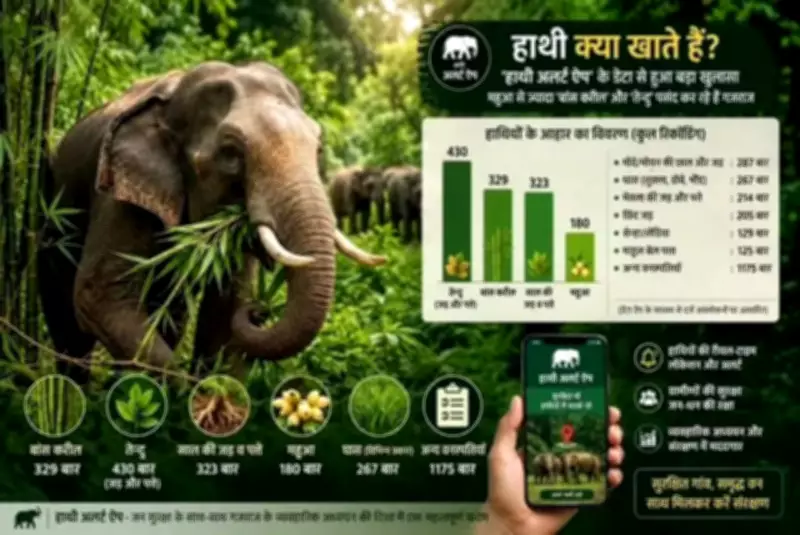
Raipur: For years, mahua flowers and fruits have carried the reputation of being the forest delicacy elephants cannot resist. However, data from Chhattisgarh's AI-generated 'Hathi Alert App' is now telling a different story — the jumbos may be far more interested in tendu roots and leaves, bamboo shoots, and sal roots than the much-talked-about mahua.
An analysis of feeding records uploaded on the app shows that while mahua consumption was recorded 180 times, elephants were found feeding on tendu roots and leaves 430 times, bamboo shoots 329 times, and sal roots and leaves 323 times. The findings are significant for a state grappling with frequent human-elephant conflict, as they offer rare field-level insight into what draws herds into particular forest patches and village edges.
The highest category in the app data was 'other vegetation', recorded 1,175 times, indicating the wide and diverse diet range of elephants in the region. Apart from tendu, bamboo, and sal, elephants were also found feeding on moyan bark and roots 287 times, different grasses 267 times, bhevla roots and leaves 214 times, chhind roots 205 times, senha/lendia 129 times, and mahul vine leaves 125 times.

Varun Jain, deputy director of Udanti Sitanadi Tiger Reserve, shared the study done on pachyderms of Gariyaband district, stating its significance because it moves elephant management beyond guesswork. Understanding what herds eat, where such vegetation grows, and how seasonal availability changes can help in identifying feeding zones, strengthening natural habitats, and planning safer elephant corridors.
The 'Hathi Alert App', initially designed to warn villagers about elephant movement and reduce loss of life and property, is also emerging as a behavioural database for wildlife managers. By recording movement, feeding habits, and conflict-prone locations, the app is helping build a clearer picture of elephant ecology in the region.
The visuals shared with the data underline the same shift — elephants feeding in dense forest patches, with infographics showing tendu, bamboo shoots, sal roots, and mahua as key diet components. The message is clear: conflict mitigation cannot be limited to alerts alone; it must also factor in food, habitat, and movement routes.
Experts say the findings could help forest teams map vegetation-rich corridors and reduce the chances of herds entering farms or settlements in search of food. In a landscape where shrinking forest resources and human expansion have intensified encounters, even a feeding chart may become a tool for saving both elephants and people.