

Traditional enterprise platforms that powered the last three decades of digital transformation are now facing a defining moment. As AI shifts businesses from transaction processing to decision-making systems, companies are grappling with whether their ERP and CRM backbones are becoming constraints, or can still serve as foundations for the AI era.
That was a discussion Times Techies had in partnership with Publicis Sapient as part of their AI that's built to deliver series.
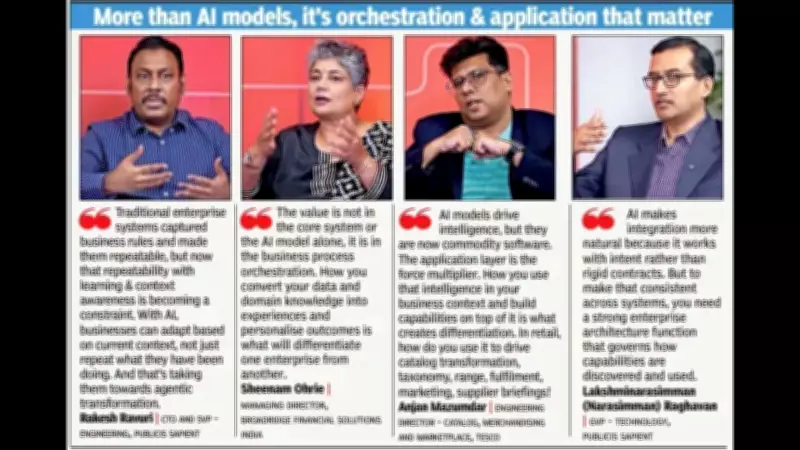
Rakesh Ravuri, CTO at digital transformation company Publicis Sapient, frames the transition starkly. “The traditional platforms have taken the world to a digitalisation era, but now, the world is moving into decisioning systems and expert systems,” he says. Traditional systems were built to encode rules and ensure repeatability. “But now, that repeatability is becoming a constraint. You want your businesses to adapt, not just repeat what it has been doing.”

He compares this with how client-server middleware – like WebLogic, ATG Web Commerce and WCS – became constraints in the cloud world that demanded a move to containers, Kubernetes, and serverless computing for scalability and speed. The limitation today shows up most clearly in customer-facing scenarios. “Your traditional rules-based system will say, you can't change the ticket, but when a human talks to you, they understand your problem and say, yes, let me see what I can do,” Ravuri says. With AI, it is becoming possible to replicate that flexibility at scale.
Yet, the story is not one of replacement, but coexistence – at least for now. Sheenam Ohrie, MD at Broadridge Financial Solutions India, says without their core engines – including mainframes that they still heavily depend on, the global fintech would not be anywhere. They are what allow Broadridge to process 10 trillion worth of transactions every day, and process over 10 billion communications annually. “Mainframes are not going anywhere in the near future,” she says.
Instead, companies are layering AI capabilities on top of these systems. Broadridge’s “Distribution GPT” personalises investor communications while relying on legacy infrastructure for execution. “The core is extremely important, but enabling customer experiences and personalisations, you need the AI layer around,” Ohrie says.
Anjan Mazumdar, engineering director for catalog, merchandising and marketplace at UK-based retailer Tesco, agrees. The core platforms, he says, have over time become masters of the enterprise’s domain data, have mastered transactions. “What we need is an intelligence layer around that,” he says. “Take the data, understand the context, surface the intelligence at the right time.” Mazumdar says baking intelligence into legacy systems is difficult, so, for now, you need a separate intelligence layer that works with the core data.
Lakshminarasimman Raghavan, group VP of technology at Publicis Sapient, argues that legacy systems evolve too slowly for AI-first ambitions. “They are evolving at a pace which may not be in sync with the pace at which you want to evolve for your customers,” he says. As businesses chase hyper-personalisation and real-time decisions, this gap is becoming critical.
So, while it may be necessary eventually to redo the heart of the system, the near term focus, Raghavan says, will be to build context from data in existing core systems and build intelligence around it. This is driving a shift in how enterprises think about platforms. Instead of focusing on buying monolithic systems, companies are increasingly building differentiated capabilities on top. “Enterprises need to be very deliberate, on where to build, what to rent, what to buy,” Mazumdar says. Core systems remain, he says, but competitive advantage shifts elsewhere – “the real capability is the orchestration layer, that is your moat.”

Easing integration AI is accelerating this transition by fundamentally changing integration. Historically, connecting systems required rigid contracts and painstaking engineering. Now, Ravuri says, AI is enabling intent-driven integration, which is less brittle than hard-coded automations that break when the system changes. “AI models are able to intuitively understand, oh, you wanted to post an order to this system, let me see what the interfaces are to post an order… I see these two interfaces which I can use. Or this interface requires an order in this format… I have this other format… I can convert it.” The impact on enterprise architecture is profound. While AI simplifies certain tasks, it introduces new layers of complexity. Ohrie warns that “simplicity comes at the cost of very complex architecture.” Systems must now manage data flows, personalization, monitoring and security simultaneously. “The entire architecture needs to evolve,” she says.





