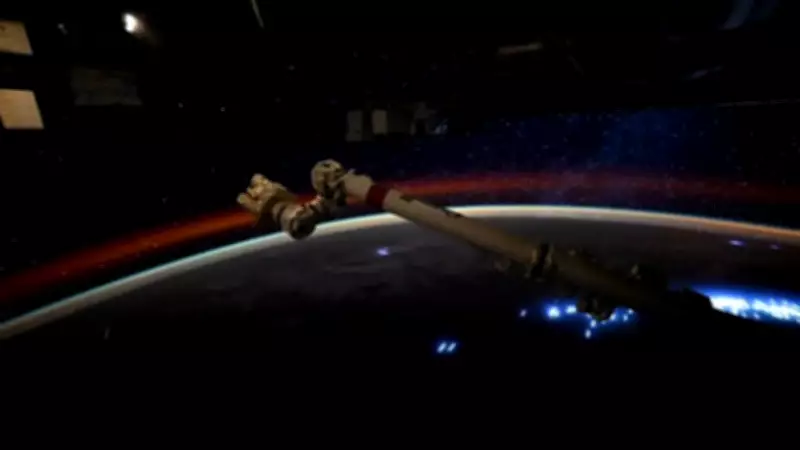
NASA Astronaut Captures Lyrid Meteor Shower from Space Station in Stunning Photos
The night sky continues to captivate scientists and astronomy enthusiasts with its array of fascinating phenomena that unfold throughout the year. A recent update from an astronaut aboard NASA's International Space Station has highlighted the ongoing activity of the Lyrid meteor shower, providing a breathtaking view from orbit.
Orbital Photography Reveals Meteor Streaks
Photographs taken by NASA astronaut Jessica Meir from the International Space Station depict multiple meteors appearing in the night sky as they approach Earth's atmosphere. These images showcase streaks of light against the backdrop of an illuminated Earth, coinciding with the peak activity of the Lyrid meteor shower, which occurs annually on April 21 and 22.
Meir captured the phenomenon while serving aboard the space station, using the station's cupola module—a specialized area with windows designed for Earth observation and photography. This orbital vantage point allows for a wider and more continuous view compared to ground-level observations, offering a unique perspective on celestial events.

Technical Details of the Space Photography
In taking the photo, a three-second exposure was applied. This exposure technique caused artificial lights from Earth to appear as streaks of light in the image. In contrast, a meteor is depicted as a streak of light positioned beneath the horizon, clearly distinguishing it from terrestrial light sources.
Understanding the Lyrid Meteor Shower
The Lyrids are an annual meteor shower resulting from Earth's encounter with dust particles from a comet. As these particles enter Earth's atmosphere, friction heats them up, creating the visible light shows in the sky. The shower is named after the Lyra constellation, as the meteors appear to originate from this specific spot in the sky, known as the radiant.
For observers in the Northern Hemisphere, it is recommended to look toward the eastern sky. This meteor shower typically features numerous meteors appearing within an hour during its peak activity.
Optimal Conditions for Earth-Based Observation
Observing the Lyrid meteor shower from Earth depends on several environmental factors. Clear weather conditions and minimal light pollution significantly enhance visibility. Urban areas with high lighting levels can hinder observation, whereas rural locations offer more favorable viewing conditions.
Unlike ground-based observations, photographs taken from space are not affected by weather disturbances such as clouds. This allows for improved visibility in orbital imagery, with fewer atmospheric interferences as meteors traverse the sky.
Timing remains crucial for optimal viewing. Most meteor activity is expected between late night and early morning on April 21 and 22, during the shower's peak period.
Visibility of the International Space Station
The astronaut also noted that observers on Earth may spot the International Space Station as it passes overhead. The station appears as a bright, steadily moving object in the night sky, visible without telescopic equipment. Its smooth and continuous motion distinguishes it from stars and aircraft, though visibility depends on the station's orbital path and local viewing conditions.
Scientific Significance of Meteor Showers
Meteor showers like the Lyrids remain a key focus of scientific research. They provide opportunities to study the interaction between Earth's atmosphere and space matter, contributing to our understanding of atmospheric phenomena and space exploration. Orbital photographs serve as valuable visual confirmations of what is observed from the surface, offering complementary data despite differences in viewing experiences.
The Lyrid meteor shower will persist for a limited time before fading, emphasizing the importance of observing during its most active phase to maximize the chance of witnessing meteors.