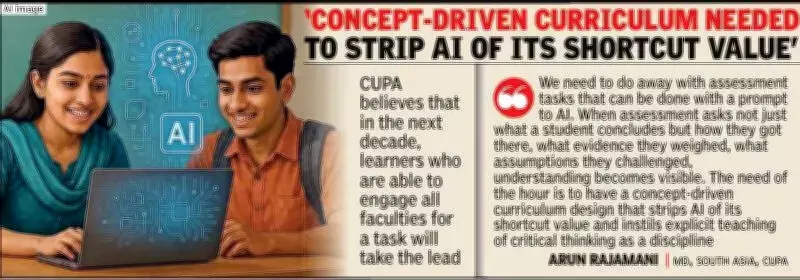
Nagpur: While studies reveal India is adopting Artificial Intelligence (AI) in education at more than double the global average, Cambridge University Press and Assessment (CUPA) has warned that this acceleration risks producing a generation of students who can use intelligent tools, but are incapable of thinking independently.
Arun Rajamani, managing director, South Asia, CUPA, expressed concern that a system which rewards memory over thinking is likely putting academic rigour under threat. Speaking to TOI, Rajamani said, "Academic rigour is not about how much a student knows. It's about what they can do with that knowledge. It's this capacity, and not recall or volume, which gives learning its lasting value."
CUPA said a report by Kantar and Google India mentioned that AI adoption in education in India is higher than the rest of the world. Rajamani also cited a Microsoft and LinkedIn study which found that more than 80% students globally use AI for summarising, problem-solving and writing support, a figure almost certainly higher in India.

Rajamani draws a sharp distinction between learners. "Capable students use AI as a catalyst by stress-testing their thinking and moving faster through what they already understand. But for the majority who have not yet built the discipline to engage with difficulty, AI offers a shortcut that produces the right answer without thinking that produces understanding," he said. Rajamani added the issue is not whether students are using AI "it is whether they are thinking while they do so".
The stakes for India are high as Rajamani says quality of education is directly linked with the country's economic ambition. "India is on course to become the world's third-largest economy by 2030. A World Economic Forum report states nearly 39% of core workforce skills will change within five years, with analytical thinking considered a critical future skill. Hence, the real risk is not that AI will replace human thinking, but it will weaken it through dependency," said Rajamani.