

AI-Enabled System Prevents Elephant-Train Collisions in Vulnerable Corridors
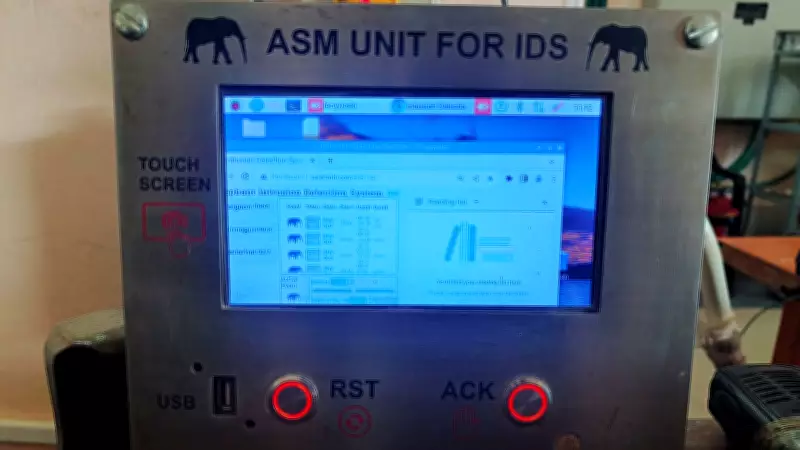
In the early hours at Binnaguri Railway Station in West Bengal's Jalpaiguri district, a sudden buzzer alarm pierces the control room's noise. Station Superintendent SK Sunil rushes to the Intrusion Detection System panel, which displays elephant movement at the 101st kilometre between Binnaguri and Dalgaon. He immediately alerts the loco pilot of an approaching train to reduce speed to 25 kmph, averting a potential disaster.
How the Technology Works
The signal originates from optical fibres laid almost 20 metres away from the railway track and three feet beneath the ground. These fibres are coiled in a specific pattern to detect vibrations caused by elephant movement. This AI-enabled Intrusion Detection System (IDS) operates on the principle of Distributed Acoustic Sensing (DAS), leveraging the Rayleigh scattering phenomenon. Laser pulses from remote OFC DAS units are continuously sent, and reflected pulses are analyzed to capture signatures based on pressure, weight, vibration, and sound waves.
Irfan Azam, a senior section engineer involved in the project, explains that this technology is similar to what security forces use in border areas to prevent infiltration. "The system creates an alarm at the station and level crossing gate after analyzing the elephant's signature," says Azam, highlighting its precision in wildlife detection.

Critical Need for Elephant Safety
Binnaguri lies in the middle of the 52-km Madarihat-Nagrakata section, one of India's most vulnerable elephant corridors along railway tracks. Sunil notes that elephants, despite their intelligence, exhibit specific behaviors due to their size. "When the loco pilot presses the horn, other animals disperse quickly, but elephants find it difficult to return down the track slope. They run on the track because it offers a clear path, making collisions likely even if the train tries to stop," he says.
This urgency is underscored by recent incidents, such as the December 20, 2025, collision in Assam's Hojai district, where eight elephants were killed by the Sairang-New Delhi Rajdhani Express. Since 2019, over 90 elephant deaths have occurred on railway tracks, emphasizing the need for proactive measures.
Expansion and Implementation
Following its commissioning in 2023 as a pilot project in the Madarihat-Nagrakata section, the Ministry of Railways has undertaken a Rs. 208-crore project to install IDS across 1,158 route kilometres of tracks. This expansion spans eight zones:
- Northeast Frontier Railway (NFR)
- East Coast Railway (ECoR)
- Southern Railway (SR)
- Northern Railway (NR)
- South Eastern Railway (SER)
- North Eastern Railway (NER)
- Western Railway (WR)
- East Central Railway (ECR)
So far, the system is operational along 141 route kilometres under the NFR. Azam details that to secure 1 km of elephant corridors, 2.5 km of optical fibres are laid. In the 155-km block section from Alipurdwar to Siliguri, a 47-km stretch is currently using the elephant intrusion detection system, with plans to install eight DAS units, each capable of monitoring 30 km of track.
Challenges and False Alarms
The system is not without challenges. Gateman Ganesh Gaur at the Red Bank level crossing gate on the Banarhat-Carron section recalls a tragic incident about a decade ago where six elephants were killed. "Most accidents happen because of baby elephants," he says, noting that the alarm sometimes goes off for every passing train, causing traffic disruptions.
False alarms can occur when the system detects vibrations from other sources, such as cattle, fallen trees, or construction machinery. Azam adds that elephants may stray from designated corridors in search of grazing, especially during lush paddy seasons, complicating detection efforts.

Future Upgrades and Collaboration
Railway officials are collaborating with the forest department to install optical fibres inside forests and upgrade the technology to detect rail fractures. According to the Ministry of Environment, Forest and Climate Change, a comprehensive report has identified 77 railway stretches covering 1,965.2 km across 14 states as priorities for mitigation. Between 2019-20 and 2023-24, 81 elephant casualties due to train collisions were reported, highlighting the ongoing need for such innovations.
With an average of four alarms daily in Binnaguri and increased vigilance during danger zones like 5 pm to 9 pm, this AI-driven system represents a significant step toward harmonizing infrastructure development with wildlife conservation in India.
