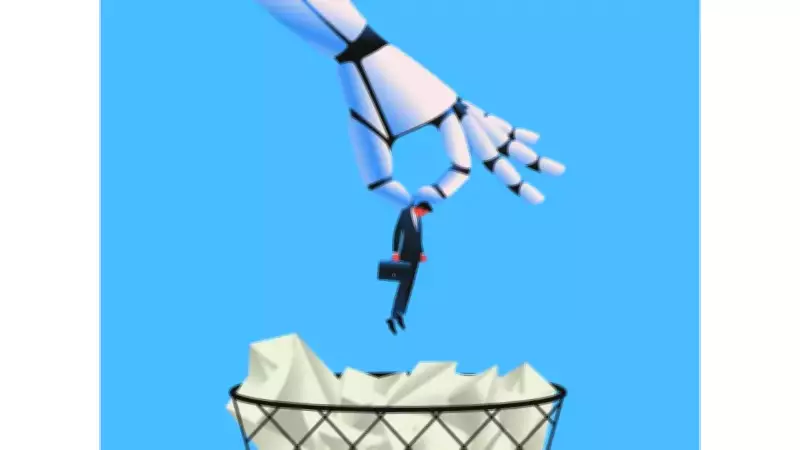
Top economist Tyler Cowen believes that artificial intelligence (AI) will not lead to widespread job losses, but it will fundamentally reshape how people work. Speaking at the Sana AI Summit at the New York Public Library, the George Mason University professor said the bigger challenge will be adapting to changing job requirements rather than dealing with unemployment.
AI Will Change Most Jobs
“AI will not bring mass unemployment. But it will change most jobs,” Cowen said at the event, as reported by Fortune. He argued that the transition could create significant psychological and social challenges as workers adjust to new expectations and workplace dynamics.
Cowen also highlighted that the impact of AI may not fall hardest on blue-collar workers, as many predict. Instead, he suggested that professionals in fields such as law, consulting and finance could face greater disruption because their careers have been built around credentials and systems that AI may increasingly automate.

“Those are actually the people who might lose. The people who will win are the people who are best at taking initiative, figuring out how AI works, figuring out how agents work, doing something different,” Cowen explained.
Status Loss Due to AI Disruption May Be Harder Than Income Loss
According to Cowen, the shift could be particularly difficult for workers whose social standing is tied to specialised expertise. “When some people go up in status, and some go down in status, I will tell you, those who lose suffer more psychologically than those who gain,” he said. He argued that many professionals may experience a sense of identity loss as AI takes over tasks that once defined their value in the workplace.
The economist compared the coming changes to previous periods of technological transformation, saying many people today have not experienced a disruption of a similar scale.
“Our lives have not really been disrupted. But what is coming is that virtually all of us will, in a radical way, have jobs that are very different from the jobs we expected,” Cowen noted.
He also criticised institutions that he believes are adapting too slowly to AI. He pointed to higher education as an example, arguing that universities are focusing on preventing AI-assisted cheating instead of reconsidering whether traditional assignments remain relevant.
“The cheating is a signal that the whole system is screwed up. Don’t blame the cheaters,” Cowen said.
Gradual Economic Impact
While some technology leaders have predicted dramatic economic gains from AI, Cowen expects a more gradual impact. He estimated that sectors such as government, healthcare, higher education and nonprofits, which together account for a large share of the US economy, will be slow to adopt new technologies. As a result, he said AI could raise long-term economic growth from around 2% to 2.5%, rather than producing the much larger increases forecast by some industry figures.
Despite the slower pace, Cowen argued that even modest growth improvements could have significant effects on issues such as government debt and economic stability.
Focus on Human Skills
Cowen advised workers to focus on skills that AI cannot easily replicate, including interpersonal communication, mentorship and physical presence.
“Being in the world and being human and being physical will be more the thing. It will be more what our lives are about,” Cowen suggested.
He added that he has already shifted much of his own time toward mentoring, public speaking and other people-focused activities. According to Cowen, qualities such as charisma and relationship-building may become increasingly important as AI handles more analytical and routine tasks.
Long-Term Outlook
Reflecting on the AI’s long-term impact, Cowen said the transition period could be uncomfortable, even if the eventual outcomes are positive.
“We will live through one of the most fantastic chapters of human history ever. We will live much longer and fix many things that go wrong with our bodies and maybe our minds and along the way, feel disoriented and sometimes demoralised,” he added.