Albert Einstein: The Man Who Redefined Reality Beyond E=mc²
It is one of history's more delightfully fitting coincidences that Albert Einstein was born on Pi Day, as if the cosmos itself decided to brand its patron saint of theoretical physics with perfect symmetry. Most people recognize Einstein as the iconic figure with wild hair, thoughtful eyes, and the famous equation E=mc², which has adorned more T-shirts than the faces of most rock stars. However, this simplistic view is unfair—it reduces his legacy to a single catchphrase, much like summarizing Shakespeare solely by "to be or not to be" or Sachin Tendulkar merely as a batsman. Einstein did not achieve greatness through one equation alone; he transformed humanity's comprehension of reality itself.
The Pre-Einstein Universe: An Illusion of Order
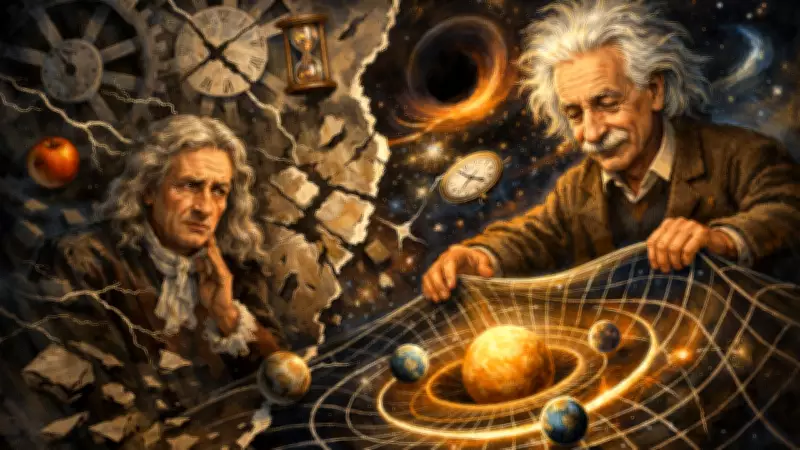
Before Einstein, physics appeared nearly complete, with the universe operating like a precise Swiss railway timetable. Matter moved predictably, forces acted consistently, and time ticked away reliably in the background, while space served as a static stage for cosmic dramas. Isaac Newton's elegant system had convinced many scientists by the late nineteenth century that the major puzzles were solved, leaving only minor loose ends. Yet, Einstein approached these anomalies with the curiosity of a cat eyeing a ball of yarn—and when he pulled, half of reality unraveled.
Einstein's Revolutionary Approach: Asking Childlike Questions
The remarkable aspect of Einstein's work was his foundation in profound, childlike questions rather than extensive experimental data. He pondered scenarios adults often dismiss, such as riding alongside a beam of light, whether time passes uniformly for everyone, if gravity differs from Newton's force, and why light behaves as both particle and wave. These inquiries were not aimed at preserving the old order but at overturning it, setting the stage for groundbreaking discoveries.

Key Contributions: A Beginner's Guide to Einstein's Legacy
To grasp Einstein's impact, let's explore his major contributions in plain language, free from intimidating equations.
The Photoelectric Effect: Light's Dual Nature
Einstein's first major breakthrough addressed the photoelectric effect, a phenomenon where light shining on metals ejects electrons. Classical physics expected brighter light to enhance this effect, but experiments revealed that frequency, not brightness, was key. High-frequency light could instantly free electrons, while low-frequency light failed regardless of intensity. Einstein proposed a radical idea: light sometimes behaves as discrete packets of energy, later termed photons. This concept, akin to raindrops versus mist, helped launch quantum physics, earning him a Nobel Prize and challenging traditional wave theories.
Brownian Motion: Proving Atoms Are Real
In Einstein's era, atoms were debated as mere mathematical tools rather than physical entities. He settled this through Brownian motion, the erratic movement of tiny particles in liquids. Einstein demonstrated that this jittery motion resulted from invisible molecules colliding with particles, turning a philosophical argument into measurable evidence. Thus, atoms were confirmed as real, with tangible consequences in science.
Special Relativity: Time Is Not Universal
In 1905, Einstein introduced special relativity, challenging the notion of a universal clock. He posited that the speed of light is constant for all observers, leading to extraordinary implications:
- Time Dilation: Time slows for objects moving near light speed, a real effect corrected in GPS satellites.
- Length Contraction: Fast-moving objects appear shorter to stationary observers, altering spatial measurements.
- Relativity of Simultaneity: Events simultaneous for one observer may not be for another, depending on motion.
This dismantled Newton's orderly universe, revealing a more complex reality.
E=mc²: Matter as Energy in Disguise
From special relativity emerged Einstein's iconic equation, E=mc², which equates mass and energy. It explains why nuclear reactions release vast energy—tiny mass conversions yield enormous outputs due to light speed's square. This revealed matter as merely one form of energy, bridging fundamental concepts in physics.

General Relativity: Gravity Bends the Universe
While special relativity reshaped time and space, general relativity redefined gravity. Einstein proposed that massive objects bend spacetime itself, akin to a bowling ball creating a dip on a stretched sheet. Planets orbit the Sun not due to a force but by following this curved geometry. Predictions confirmed include light bending near massive objects, time slowing in strong gravitational fields, and the existence of black holes and gravitational waves, detected a century later.
Bose-Einstein Statistics and Lasers
Einstein collaborated indirectly with Indian physicist Satyendra Nath Bose on Bose-Einstein statistics, describing particles called bosons that can occupy the same quantum state, leading to phenomena like Bose-Einstein condensates. Additionally, his work on stimulated emission laid the groundwork for lasers, now vital in technology from barcode scanners to medical surgeries.
Final Thought: Einstein's Legacy of Complexity
Einstein fundamentally disrupted the comfortable universe inherited from Newton. Before him, the cosmos seemed orderly: space was a stage, time a clock, gravity a gentle tug, matter solid, and light a wave. Einstein revealed that time stretches, space bends, light has dual behavior, matter converts to energy, and gravity is geometric illusion. He did not complicate physics; he uncovered that reality was already intricate, paving the way for ongoing scientific exploration into the universe's strangeness.