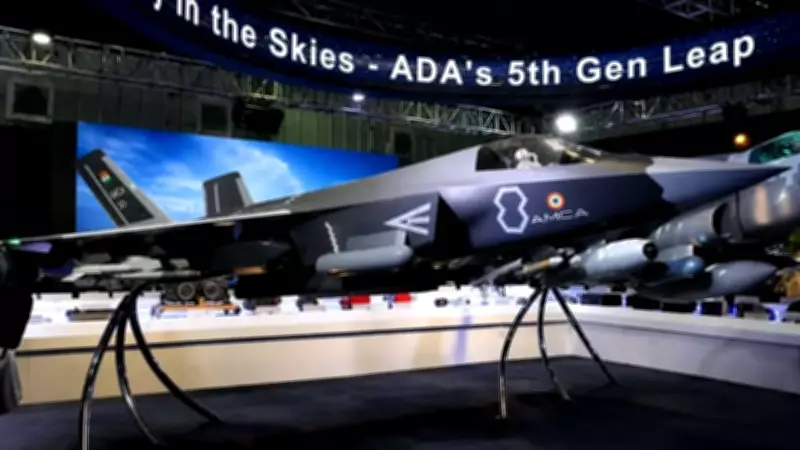
India's ambitious fifth-generation stealth fighter has entered a decisive phase, with the defence ministry formally issuing a Request For Proposal (RFP). The Advanced Medium Combat Aircraft (AMCA) is far more than just another combat aircraft project. It is expected to become the centerpiece of India's future air combat strategy in an era increasingly dominated by stealth platforms.
Urgency of the AMCA Program
With a steady decline in squadron strength and an increasingly challenging regional security dynamic, the urgency of the AMCA program is growing rapidly. China has already operationalized the J-20 stealth fighter in considerable numbers, while Pakistan is reportedly moving closer to acquiring the Chinese J-35 stealth fighter. While India is acquiring additional Rafale and Tejas fighters to strengthen combat mass, the Indian Air Force (IAF) requires AMCA to dominate in heavily contested airspace featuring advanced radars and air defence systems.
Importance of AMCA
The AMCA is expected to shape the country's air combat capability and aerospace ecosystem for decades. It represents India's entry into fifth-generation warfare centered around stealth technology, advanced sensors, electronic warfare, and AI-assisted operations. The twin-engine 25-tonne aircraft will feature a stealth design with an internal weapons bay, advanced sensors, and sensor fusion, allowing it to operate effectively in heavily contested airspace. It will perform air superiority, deep strike, and electronic warfare missions.

Beyond its military importance, the AMCA is also viewed as a transformational project for India's defence industry. India is developing indigenous capabilities in stealth manufacturing, advanced composites, mission software, and aerospace materials. The government's decision to involve private sector companies alongside traditional defence firms is seen as a major structural shift aimed at creating a domestic aerospace manufacturing ecosystem, rather than relying on a single public-sector entity.
AMCA Engine Development
The most critical aspect of the AMCA program is developing engine technology. While the initial AMCA Mk1 variant will fly with the American GE F414 engine, India's strategic objective is to develop a more powerful engine for its Mk2 variant. Jet engine technology remains the most complex and difficult area of aerospace engineering, mastered by only a handful of countries. India is actively seeking foreign collaboration with global aerospace giants like Rolls-Royce and Safran.
Manned-Unmanned Teaming
AMCA is also expected to become the centerpiece of India's future Manned-Unmanned Teaming (MUM-T) warfare doctrine with loyal wingman drones. In a high-tech network-centric warfare scenario, AMCA, flying alongside multiple unmanned systems, will coordinate with them in contested airspace while reducing risk to human pilots.
The AMCA program is not just about building India's first stealth fighter, but also shaping the whole doctrine of future warfare and defence industry ecosystem. The timely execution of the program will be crucial for both the IAF's combat preparedness and India's long-term goal of self-reliance in defence.