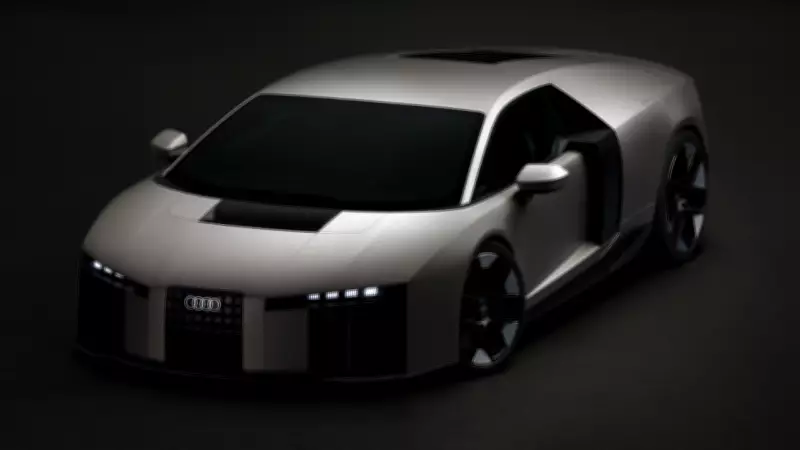
German automaker Audi has officially unveiled the new Audi Nuvolari, a high-performance hybrid hypercar that serves as the spiritual successor to the iconic R8. The Nuvolari will enter production in early 2027, with global output capped at 499 units. It is the first production vehicle to feature Audi's new design language, marking a departure from the brand's traditional alphanumeric naming strategy. Instead of reviving the R8 badge, the hypercar is named after Tazio Nuvolari, the pre-war racing driver who later competed for Auto Union, one of Audi's predecessor brands. Development of the Nuvolari took approximately 14 months after the project was approved in March 2025.
Powertrain and Performance
The Audi Nuvolari is powered by a 4.0-litre twin-turbo V8 engine paired with three electric motors, delivering a combined output of 987bhp. The V8 alone produces 789bhp and 729 Nm of torque, while each electric motor contributes 148bhp. Power comes from a 7.3kWh battery pack, larger than the 3.8kWh unit used in the Temerario. Although it shares its engine and motor outputs with the Temerario, the Nuvolari gains an additional 80bhp through revised software, a new torque-management system, and the larger battery. The hypercar accelerates from 0-100kph in 2.6 seconds, reaches 200kph in 6.8 seconds, and has a top speed of over 350kph.
Advanced All-Wheel Drive and Driving Modes
Audi has equipped the Nuvolari with its new Quattro Predictive Ride all-wheel-drive system. Using data from steering, acceleration, grip, and vehicle movement sensors, the technology continuously adjusts torque distribution. It also works alongside the braking system and active aerodynamic components to improve traction. Drivers can select from five modes: E-Hybrid, Balanced, Dynamic, Dynamic+, and Track. Audi says the energy-management system adapts to road conditions and driving inputs, combining regenerative braking and coasting functions to maximize efficiency. The front electric motors recover much of the braking energy, while launch control uses stored battery power for maximum acceleration.

Chassis, Brakes, and Aerodynamics
The Nuvolari rides on 21-inch wheels fitted with Bridgestone Potenza tires and uses a brake-by-wire setup with carbon-ceramic discs, 10-piston front calipers, and four-piston rear calipers. Audi claims the upgraded cooling system improves heat dissipation by up to 21 percent and is designed to withstand extreme braking demands. Built around a spaceframe chassis, the Nuvolari is the first production Audi to feature an extensively carbon-fiber exterior. Most body panels are made from carbon-fiber-reinforced polymer, while heat-resistant materials are used in high-temperature areas. Aerodynamic efficiency has been a key focus. The hypercar features a front splitter, large cooling intakes, and a rear diffuser, along with active aerodynamic systems inspired by Formula 1 technology. Its rear wing can switch between Closed, Low Downforce, and High Downforce settings, while a drag reduction system lowers the wing on straights. Under braking, the wing moves to its high-downforce position, generating more than 400kg of aerodynamic load.
Design and Styling
In terms of design, the new Audi Nuvolari adopts the brand's latest design language with a low-slung stance, wide proportions, and a body shaped to maximize aerodynamic efficiency. Up front, the hypercar features a large grille, slim lighting units, and sizeable air intakes that help cool key components, while aerodynamic detailing has been integrated into the bumper design. The side profile is characterized by a sweeping roofline, pronounced rear wheel arches, and large 21-inch alloy wheels. Carbon-fiber body panels help reduce weight, while carefully designed air channels improve airflow around the vehicle. At the rear, the Nuvolari gets a full-width lighting element, a large diffuser, and an active rear wing that automatically adjusts according to speed and driving conditions to enhance stability.