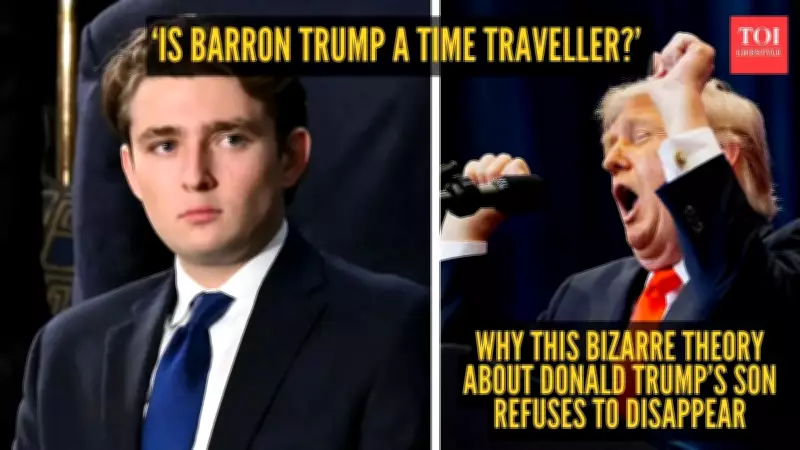
The internet has always had a fascination with coincidences. But every once in a while, a theory emerges that is so oddly specific, so layered with history, mystery, and viral intrigue, that it develops a life of its own.
One such theory revolves around Barron Trump, the youngest son of Donald Trump, and the bizarre claim that he may somehow be connected to time travel. Over the years, the theory has spread across Reddit forums, TikTok videos, YouTube explainers, and conspiracy threads, pulling millions of curious users into an internet rabbit hole involving 19th-century novels, inventor Nikola Tesla, and an unusual series of coincidences that many online users still describe as “creepy.”
But where exactly did this theory come from? And why has it managed to survive long after being repeatedly debunked? Here’s a closer look at the origins of one of the internet’s most unusual conspiracy theories.

The Old Novels at the Centre of the Theory
The theory largely traces back to a little-known American author named Ingersoll Lockwood, who wrote a set of fantasy-adventure novels in the late 1800s. Among them were Travels and Adventures of Little Baron Trump and His Wonderful Dog Bulger (1889) and Baron Trump’s Marvelous Underground Journey (1893). The books, which are now available in public archives, feature a wealthy young aristocrat named “Baron Trump” who lives a privileged life and embarks on mysterious journeys.
For decades, the novels remained obscure literary curiosities. That changed dramatically after Donald Trump’s 2016 presidential victory, when internet users rediscovered the books and began circulating screenshots online. The similarities immediately caught attention. The fictional character’s name – “Baron Trump” – sounded remarkably close to Barron Trump. Internet users also highlighted that the fictional Baron is guided by a mentor figure named “Don,” a detail that conspiracy theorists quickly linked to Donald Trump. Soon, social media posts began framing the books as “evidence” that the Trump presidency had somehow been predicted more than a century earlier.
The Book That Intensified the Conspiracy
While the Baron Trump novels sparked the initial curiosity, another Lockwood book pushed the conspiracy into viral territory. The novel, titled 1900 or The Last President, tells the story of political unrest and social chaos after a controversial outsider unexpectedly wins the presidency. Following the 2016 US election, online users began comparing passages from the novel with real-world political protests and divisions seen across America. Some viral posts claimed the parallels were “too accurate” to ignore. Others pointed to mentions of unrest in New York and portrayed the book as a prophetic warning about modern politics.
Historians and literary scholars, however, have repeatedly cautioned against overstating these similarities. Themes involving anti-establishment politics, wealthy elites, and public unrest were already common in American political writing during the late 19th century. In many ways, experts argue, the internet amplified selective details while ignoring the larger fictional context of the books.
How Nikola Tesla Became Part of the Mystery
The conspiracy took an even stranger turn when internet users connected it to Nikola Tesla. Tesla, widely regarded as one of history’s most visionary inventors, has long been surrounded by myths and speculation because of his futuristic ideas and unconventional experiments. After Tesla died in 1943, the US government reviewed some of his research papers and documents. Historical records confirm that one of the experts associated with examining parts of Tesla’s material was John G. Trump, an MIT professor and Donald Trump’s uncle.

That real historical connection became the backbone of a much larger internet narrative. Online conspiracy communities gradually transformed the story into a fictional chain of speculation: Tesla supposedly discovered time travel, John G. Trump allegedly accessed Tesla’s hidden research, the Trump family inherited secret scientific knowledge, and Barron Trump may somehow be connected to it. There is, however, no factual evidence supporting any of these claims. No scientific record suggests Tesla built a working time machine, and no credible evidence has ever linked Barron Trump to anything beyond internet speculation.
Why the Theory Became Internet Folklore
The Barron Trump theory reflects how modern internet culture often operates: a mix of coincidence, pattern recognition, and viral storytelling. Experts studying online misinformation and conspiracy culture have long noted that theories gain traction when they involve famous personalities, mysterious historical details, hidden knowledge, unexplained coincidences, and emotionally engaging narratives. The Barron Trump theory combines all of them.
The existence of the books is real. The Tesla connection is real. The similarities are visible enough to spark curiosity. And because Barron Trump himself maintains a relatively private public image, the mystery only deepened online. TikTok creators, Reddit users, and YouTube channels further amplified the theory through dramatic edits, side-by-side comparisons, and sensational explanations, turning a niche conspiracy into mainstream internet folklore.
Separating Fact from Internet Fiction
A closer look at historical records makes the distinction clear. What is factual: Ingersoll Lockwood’s novels genuinely exist, the fictional character “Baron Trump” appears in them, John G. Trump was a respected MIT professor, and he was involved in reviewing material related to Nikola Tesla after Tesla’s death. What remains unsupported: Barron Trump being a time traveler, Tesla inventing time travel, secret Trump family technology, and the books accurately predicting future political events. Researchers largely view the theory as a modern example of how the internet pieces together unrelated facts to create compelling narratives.
Why People Still Keep Revisiting It
Despite lacking evidence, the theory continues resurfacing every few months because it sits at the perfect intersection of history, politics, mystery, and internet culture. For many people online, the fascination is no longer about genuinely believing the theory. Instead, it has become part of a broader internet obsession with decoding coincidences and turning obscure historical details into viral mysteries. And perhaps that is why the Barron Trump conspiracy refuses to disappear: not because it is believable, but because it feels like the plot of a thriller the internet collectively does not want to stop watching.