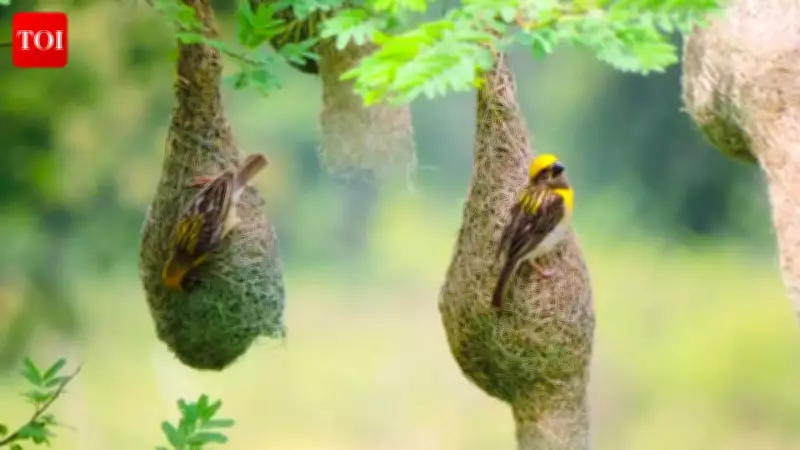
If Charles Darwin could scroll through today's wildlife videos, he would likely pause at footage of the baya weaver and remark, 'Now that is natural selection at its finest.' Over 150 years ago, Darwin introduced the concept of evolution by natural selection in his 1859 book 'On the Origin of Species,' which posits that organisms with traits best suited to their environment have a greater chance of surviving and passing on those traits. A century and a half later, a tiny weaver bird is proving his theory right.
The Baya Weaver: A Bird Following Darwinian Theory
The baya weaver is a sparrow-sized bird with a yellow crown, found throughout India and much of South and Southeast Asia. At first glance, it appears plain and unremarkable. However, during breeding season, it constructs nests that hang from palm branches like lanterns or upside-down bottles. One internet user described them as 'nature's most overengineered apartment complex.' These nests are not just artistic but highly functional.
The Science Behind the Work of Art
Scientists believe these nests represent one of evolution's smartest solutions to a longstanding problem: snakes hunting for eggs. The male weaver weaves a hanging basket from grass and leaves, suspends it from thin branches often over water, and adds a narrow, downward-facing entrance tube. This design makes it extremely difficult for predators to access the eggs. A snake must grab a swinging structure, wiggle through a tight tunnel, and scramble face-up into the nest chamber—a challenge akin to robbing a bank while hanging upside down from a rope bridge during an earthquake.

Research supports this. A major study in 'Proceedings of the Royal Society B' found that birds with hanging nests and entrance tunnels lose fewer nestlings to predators, and their chicks live longer and develop more days before fledging. Essentially, safer homes lead to more surviving offspring.
Scientists call this 'convergent evolution' when unrelated bird families, such as weaverbirds and icterids, independently evolve similar elaborate hanging nests. Different birds face the same problem—predators—and evolution arrives at a comparable solution.
The astonishing part is that baya weavers do not consciously understand snakes or blueprints. Evolution works without thought. Birds that happened to build trickier nests raised more chicks, and generation after generation, those nesting instincts prevailed. As one Reddit user noted, 'It's not understanding. It's the form that survived.' Darwin would have appreciated that perspective.
Decoding the Baya Weaver's 'Brilliance'
Beyond snake defense, baya weaver nests are climate-control masterpieces. Research from Malaysia indicates these nests help stabilize temperature and airflow, creating a comfortable nursery for chicks. Depending on local weather, weavers adjust their building techniques, much like contractors adhering to building codes.
Studies also reveal a clear division of labor: males do almost all the construction, twisting grass and leaves into elaborate structures using only their beaks and feet. They showcase a half-finished 'helmet' nest to attract a female. She inspects it; if she approves, he continues building. If not, he abandons it and starts anew. Nest quality is a dealbreaker—a sturdy, safe nest helps the male secure a mate, while a ramshackle one is rejected. Good architecture is an impressive feat in the bird world.
Put together, these nests combine design, climate adaptation, snake defense, and even romance—all woven into a single swinging creation. However, snakes have not given up; this ongoing tug-of-war drives both predator and prey to evolve trickier strategies. For a living example of how natural selection shapes behavior, one need only look up at a baya weaver's nest.
The brilliance of these nests serves as a reminder that genius solutions can emerge from a slow grind of trial, error, and survival—not from conscious thought or grand plans. The baya weaver's nest hangs in the monsoon wind, oblivious to Darwin, evolution, or engineering, yet it surpasses all three at their own game. That is a truly practical flex.
About the Author: The TOI Lifestyle Desk is a dynamic team of dedicated journalists who curate a vibrant tapestry of lifestyle news for The Times of India readers, covering fashion, travel, food, wellness, and more.