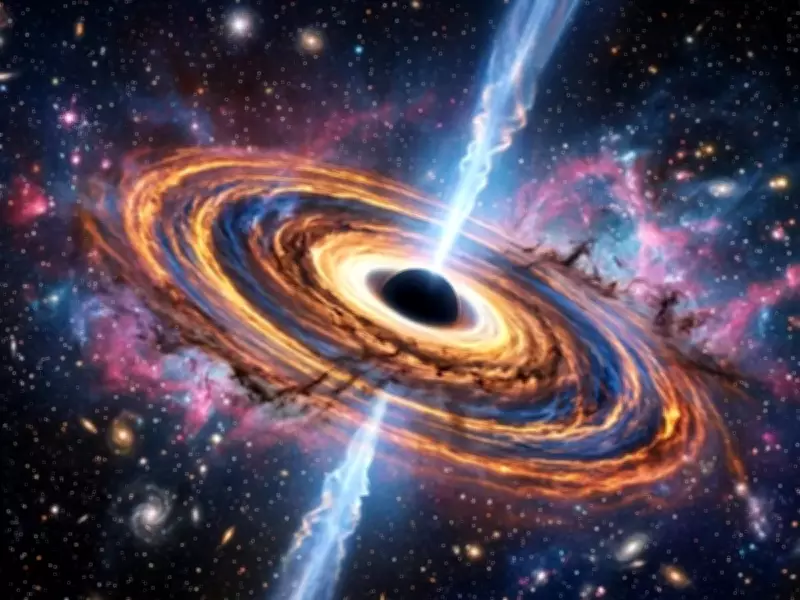
Black holes are renowned for harboring secrets, but scientists have now uncovered a periodic signal originating from what was once a star destroyed by a black hole. This signal repeats every 20 days in the form of pulsations, offering what researchers believe is the clearest evidence for a phenomenon predicted by Albert Einstein a century ago.
Tidal Disruption Events and AT2020afhd
According to experts, these findings shed light on tidal disruption events, which occur when a star passes too close to a supermassive black hole and is torn apart by its immense gravity. The remnants form a bright disk of matter and sometimes generate high-powered jets. The specific event, designated AT2020afhd, took place in a galaxy 120 million light-years from Earth. Scientists studied this phenomenon over time, recording wobbling changes in its luminosity.
Frame-Dragging and Einstein's General Theory of Relativity
Researchers explain that the observed wobble is attributed to frame-dragging, a concept from Einstein's General Theory of Relativity. This theory describes how gravity affects the structure of spacetime. When a massive body rotates, it not only bends spacetime but also twists it. This effect, known as Lense-Thirring precession, is akin to a spinning object dragging the surrounding space like a fabric. The twisting influences nearby matter similarly to gravitational forces, though no direct forces are applied.

Discovery in the Debris of a Star's Destruction
Frame-dragging was observed in the debris of the star's destruction. A disk of hot, luminous gas formed around the black hole, while some gas was ejected in two high-speed jets. Physicists noted that both the disk and jets oscillated periodically relative to each other. Dr. Cosimo Inserra of Cardiff University, a contributor to the research, stated that this provides strong evidence that the disk and jet are physically connected and precessing together. The motion repeats roughly every 20 days, creating a clear and predictable pattern.
Verification with Two Telescopes
To confirm the signal, scientists used NASA's Neil Gehrels Swift Observatory and the Karl G. Jansky Very Large Array. These instruments detected a common periodicity, with X-ray emissions increasing and decreasing in parallel with changes in radio emissions. The presence of periodicities in two different types of light reduces the likelihood of accidental detection, strengthening the case for an astrophysical source.
Significance of the Discovery
Frame-dragging has been studied before, including NASA's Gravity Probe B mission on Earth, but the gravitational force in that case was much weaker. Black holes provide an ideal setting for testing this theory due to their strong gravitational fields. Moreover, this wobble could serve as a tool to estimate a black hole's spin, one of its key parameters. Researchers from the National Astronomical Observatories of the Chinese Academy of Sciences explained that understanding spin helps scientists determine how black holes eject plasma jets and influence their environment.
Future Implications for Space Research
This discovery reveals that black holes are more dynamic than previously thought. They are not merely devouring everything in their path but can create complex patterns of destruction that unveil hidden laws of physics. Einstein hypothesized the twisting of spacetime a century ago, and now astronomers have observed it directly. Future missions like the Einstein Probe will detect rapid cosmic events and study them in detail, promising further insights into the universe's mysteries.