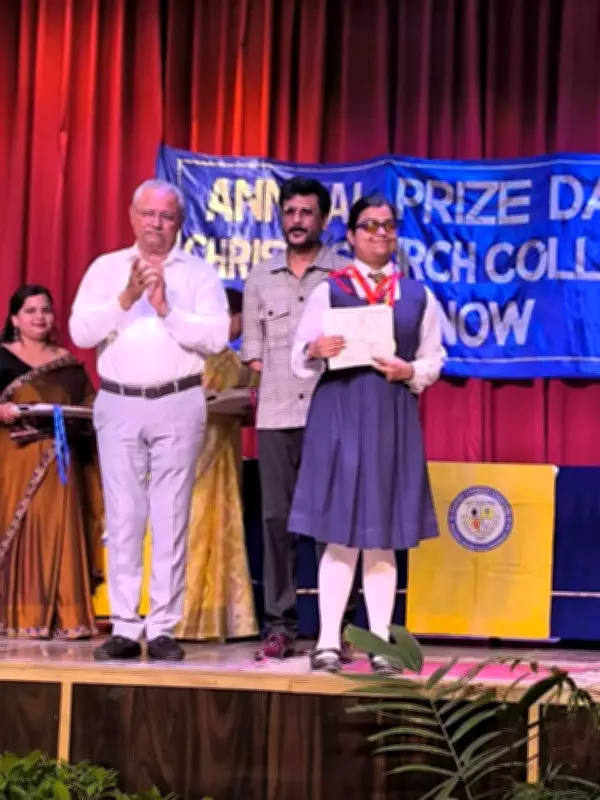
Lucknow: After Sarah Moin, a blind, speech and hearing-impaired student of Christ Church College, scored 98.7% in her ISC exams, a question doing the rounds is — How do children like her understand and learn about the world? The answer, experts say, lies in their fingers, which play the role of eyes, ears and voice.
Learning Through Touch
They learn by touching things. They feel objects to understand their shape and size. They also learn words when someone writes letters on their palm or use Braille.
Explaining this, neurologist Prof Ravi Uniyal from KGMU said the brain becomes stronger in other ways. This ability is called neuroplasticity. When children cannot see or hear, their brain learns to use touch and memory better. This helps them remember things and understand patterns.

Because of this, they do not see pictures like others. Instead, they make a map in their mind using touch. For example, they remember rooms by counting steps, feeling doors and objects. They can even recognise people by touch and vibrations of their footsteps. “They also develop home signs, which involve a combination of customised gestures, tactile communication to talk with the family members,” he added.
Role of Teachers and Tools
Teachers play a big role in their learning. They teach step by step — first letters, then words, and then full ideas. They use tools like Braille books and special devices like Orbit reader. Learning may take time, but understanding becomes strong. Prof Uniyal said that in daily life, these children follow simple routines such as moving carefully, eating and dressing step by step, and communicating through touch.
Inspiring Examples
There are many inspiring examples. Helen Keller could not see or hear but became a famous writer. Haben Girma became a lawyer and studied at a top university.
Emotions and Expression
Experts say these children also feel emotions like everyone else. They feel happy, curious and sometimes upset. The difference is only in how they express it. “Such individuals can understand patterns traced on their skin and respond in the same way,” said Shweta Singh, a clinical psychologist.
These examples show that nothing is impossible. Experts say that with the right support from parents and teachers, such children can study, work and achieve their dreams.