Nature is full of tricks and deceptive tactics, but the recent discovery made by scientists will leave you amazed. Researchers discovered that blister beetle larvae are able to produce floral smells to lure unsuspecting bees. As a result, these larvae hitch rides back to the nests of bees and feed on their eggs along with stored food. The incredible discovery has become the first known case of an animal mimicking the scent of a flower. It is believed that the finding will add a new fascinating twist to the already complicated story of the interrelations between pollinators and insects. The discovery was reported in a recent preprint study, which was further emphasized in Science magazine.
Deception is common in nature, but this case is more intricate
Plants have been deceiving pollinators for ages. For instance, certain types of orchids are known to copy the appearance and the scent of the female bees so that males attempt to mate with these flowers and pollinate them. According to entomologist May Berenbaum of the University of Illinois Urbana-Champaign, deception is very common in nature. However, the recently discovered case is far more complicated in its nature because it involves an animal copying a plant rather than vice versa. Scientists say that this is the first time when an animal is observed to create floral scents to manipulate pollinators in some way.
An amazing parasitic trick played by a tiny beetle
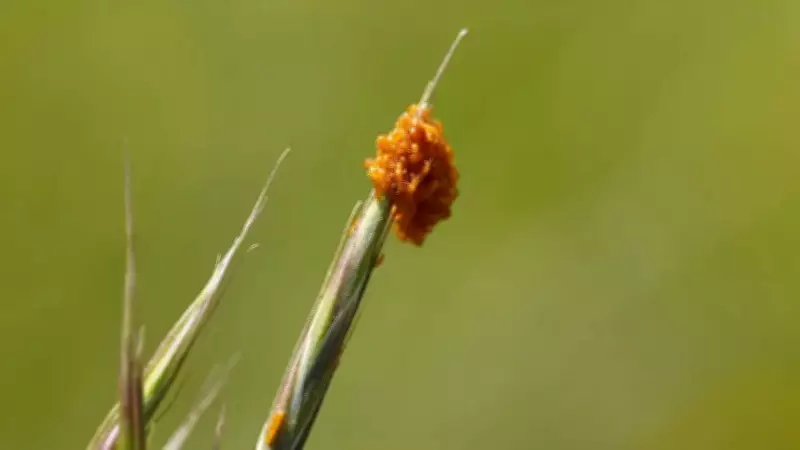
It all begins with the European black oil beetle (Meloe proscarabaeus). First of all, larvae hatch from eggs and climb on grass stalks, forming tight clusters. The most intriguing part is that these larvae not only look like flowers but also release a bouquet of floral-smelling chemicals. Once attracted to what looks like a nectar-filled flower, the bee grabs the cluster of larvae. Later, the unsuspected bee carries the larvae back home to its nest; as a result, it delivers its enemies, which start consuming bee eggs, stored pollen, and nectar once reaching their destination.

The man who discovered an extraordinary trick
This discovery was made by Ryan Alam, who is a chemical ecologist at the Max Planck Institute for Chemical Ecology, located in Germany. Being interested in blister beetles, famous for creating cantharidin as a toxin, Ryan collected 40 specimens from German meadows. Then, he raised these beetles in the laboratory and let them reproduce to obtain hundreds of larvae. Being surprised with the behaviour of larvae after being placed outdoors, he collected some samples of larvae and analyzed them using a sophisticated tool.
Floral perfume created by insects
As a result, using the method of gas chromatography-mass spectrometry, Ryan and his colleagues discovered that larvae produced dozens of chemicals common for flowers. Some of the abundant chemicals were linalool oxide and lilac aldehyde. In general, it turned out that there were 17 different chemicals which larvae released, and most of them were connected to the smell of plants. At first, scientists were shocked by this discovery, saying that the composition of these larvae seemed to be a bouquet of flowers. Scientists concluded that the larvae are capable of creating floral scents rather than copying the smell from somewhere.
Scientists say that the discovery is 'Beautiful' and 'Sophisticated'
Other scientists, who did not participate in this study, said that the discovery was extraordinary. Chemical ecologist Consuelo De Moraes from ETH Zürich called it a 'beautiful study' emphasizing the amazing sophistication of interactions between insects. The discovery helps us better understand how mimicry and evolution work. Scientists assume that there may be other cases of scent-based deceiving performed by various insect species. Therefore, this study might help to discover more sophisticated and unexpected relations in the ecology world in the future. Though this study is just a preprint and does not pass peer review yet, scientists claim that the evidence seems convincing.