Bumblebee Queens Defy Odds by Surviving Underwater for Days
Some scientific discoveries feel immediately intuitive, like water being wet or fire being hot. Others, however, sound as if researchers stumbled into a science fiction script and decided to test its plausibility. In a remarkable twist, bumblebee queens have been found to survive underwater for days, not just fleeting moments. This finding, which might seem straight out of a Transformers movie, is grounded in real biological mechanisms that scientists are only beginning to unravel.
The Winter Diapause: A Biological Pause Button
To understand this underwater survival, one must first explore the winter life of a bumblebee queen. As temperatures plummet and flowers vanish, the queen enters a state known as diapause. This biological pause button dramatically slows her metabolism, halts development, and reduces energy consumption to a fraction of normal levels. She burrows underground, conserving resources in a state akin to suspended animation until spring arrives for colony rebuilding.
However, these underground burrows are not always safe havens. Rainwater infiltration, snowmelt, and shifting water tables can flood these cavities, submerging the queen in an accidental aquarium. For most creatures, this would spell doom, but for the bumblebee queen, it's merely an inconvenient plot twist.

Physiological Tricks for Underwater Endurance
Experiments have demonstrated that queens of certain species can survive several days of submersion with surprisingly high success rates. This endurance is not due to a single superpower but a clever combination of strategies that keep the queen alive until water recedes.
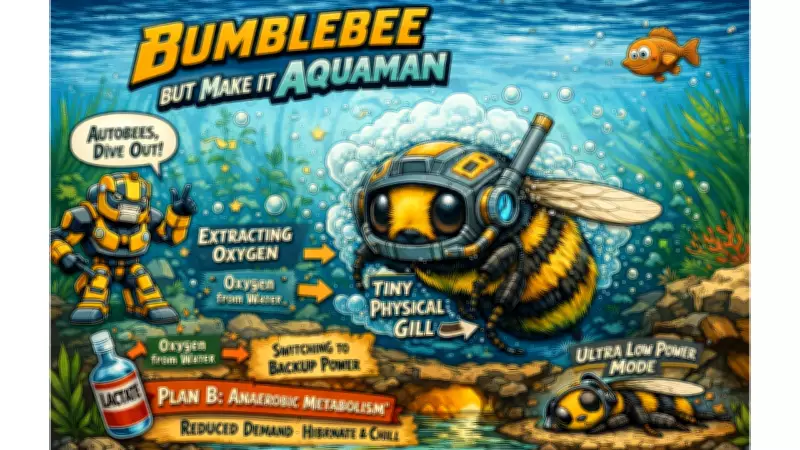
Oxygen Extraction via Physical Gills: Even underwater, water contains dissolved oxygen. Bumblebee queens lack gills, but they may utilize a thin layer of trapped air around their bodies, functioning as a physical gill. Oxygen diffuses from the water into this air layer and then into the bee's respiratory system, enabling slow gas exchange. This inefficient yet sufficient system supports basic metabolic processes.
Anaerobic Metabolism as Emergency Backup: When oxygen becomes scarce, the queen's body can shift to anaerobic metabolism, producing energy without oxygen. This less efficient pathway leads to lactate accumulation but provides a temporary energy source. Increased lactate levels in submerged queens confirm this metabolic backup system is active.
Metabolic Slowdown to Ultra-Low Power Mode: The most critical factor is the queen's ability to drastically reduce energy needs. Already in diapause with a metabolic rate over 90% lower than normal, submersion further slows metabolism. Carbon dioxide production measurements show dramatic declines, indicating the queen shifts into an ultra-low-power mode. This minimal energy consumption allows limited oxygen to sustain her for extended periods.
Ecological Significance and Evolutionary Insurance
This survival ability holds significant ecological importance. A colony begins with a single queen emerging from diapause in spring. If winter flooding routinely killed queens, populations could collapse in flood-prone regions. The capacity to endure temporary submersion acts as evolutionary insurance, ensuring queens can establish colonies once conditions stabilize.
From a broader perspective, this discovery challenges human notions of resilience. Survival is often portrayed as a contest of strength or aggression, but the bumblebee queen exemplifies a different principle. By reducing her metabolic footprint, conserving energy, and waiting patiently, she endures overwhelming environments without direct resistance. In technological terms, she switches to power-saving mode, akin to a biological submarine configuration.
Ongoing Research and Broader Implications
Researchers continue to investigate the finer details, such as precise oxygen diffusion mechanisms and survival limits. Evolution has provided the outcome, leaving scientists to decode the biochemical adjustments involved. Even without full technical clarity, the broader picture is astounding: a dormant bumblebee queen, weighing less than a coin, can survive conditions that would defeat many larger animals through metabolic restraint, chemical flexibility, and physiological efficiency.

In a world captivated by power and spectacle, one of nature's most impressive survival strategies belongs to this unassuming insect. The next time Bumblebee is mentioned in jest, remember that some bumblebees possess a quiet talent for transformation, waiting patiently underwater until the world above dries out and life can rebuild.