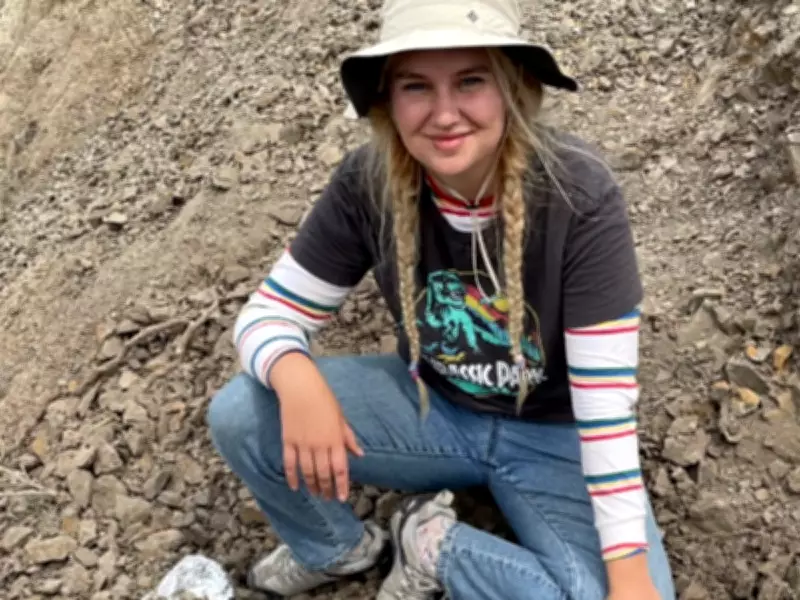
A university field trip of students from Chapman University to the Badlands of Montana resulted in an actual discovery of a fossil. This happened when a Chapman student, named Sarah Wallace, identified a little piece of bone peeking out of the ground during a dinosaur excavation in 2021. Initially perceived as any tiny fragment, it eventually became a massive undertaking in the name of science, encompassing excavation, plaster jacketing, transportation, and laboratory examination.
According to Chapman University Newsroom, this incident happened while Sarah Wallace was taking an honours course on 'Dinosaurs in Science and Media.' The fossil later became known as the 'Dream Bone.'
A Classroom Lesson That Became a Real Discovery
Part of the reason the incident received such wide coverage is that Wallace is not a palaeontology student. The news reported that Wallace had been enrolled in a television writing and production program offered by Chapman University before enrolling in the field program through their honours program. However, according to the university's report, students were trained in identifying layers of sediments, as well as discerning between rocks and fossils, before embarking on the field program. This training became invaluable once Wallace saw a fragment of bone protruding from the earth in the Montana Badlands.

Why Did Researchers Consider the Fossil Significant?
This discovery was considered important since fossils of gryposaurs from Montana are quite rare. The fossil specimen could represent only the second gryposaurus identified in the state if the classification holds after continued study. The genus Gryposaurus was one of the duck-billed herbivorous dinosaurs that existed on Earth during the Late Cretaceous period. Reportedly, the Gryposaurus fossils had previously been found in Alberta, Montana, and Utah.
The Origin of the 'Dream Bone' Nickname
The unusual nickname attached to the fossil became part of the story's wider appeal. According to Chapman University Newsroom, Wallace said she had dreamt about uncovering a huge dinosaur fossil the night before the discovery. After the excavation team confirmed the significance of the specimen, Wallace was invited to help name it, following a tradition sometimes observed during field discoveries. That moment led to the fossil being informally called the 'Dream Bone.' Other news portals also reported that her dream involved a massive dinosaur bone towering above her before she found the actual specimen the next day during fieldwork. Even so, the scientific work surrounding the fossil remained methodical. Chapman University repeatedly described the specimen as requiring excavation, stabilisation and transport before further research could continue. The unusual name given to the fossil became one of the contributing factors that made the story interesting.
From Montana's Dirt to the Laboratory
The fossil's journey did not end in the field. Reportedly, students and researchers later worked to plaster-jacket the specimen, a process used to protect fragile fossils during transport. The university described how the fossil jacket, weighing thousands of pounds, was eventually moved out of the excavation site and transported for preparation work. The heavy fossil jacket was later transferred out of the excavation area to be prepared. As mentioned in the further article published by Chapman University, the students continued to carefully clean out rock and dirt off of the fossil right in the Dino Lab at Chapman University, California. This discovery became the basis for a larger research program conducted under Jack Horner, a well-known palaeontologist famous for his studies of dinosaur behaviour and his consultancy on 'Jurassic Park.'

A Fossil Story with a Human Element
It is not just the fact that there is a dream associated with the 'Dream Bone,' but rather how training, observation, and field science combined to bring about the moment. Chapman University explains that Wallace had trained for days on identifying fossils before finding this particular bone fragment among Montana's rocky land. Once discovered, it went through all the same steps as any other significant palaeontological find: excavation, documentation, preservation, transport and laboratory testing. The story also illustrates students' contributions to scientific field research. In this case, Wallace wasn't a veteran palaeontologist, yet she had enough training to recognise that the bone was something special, lying hidden beneath the dirt. In the end, that scientific observation turned a regular fieldwork day at the university into the discovery of a fossil that scientists still examine today.