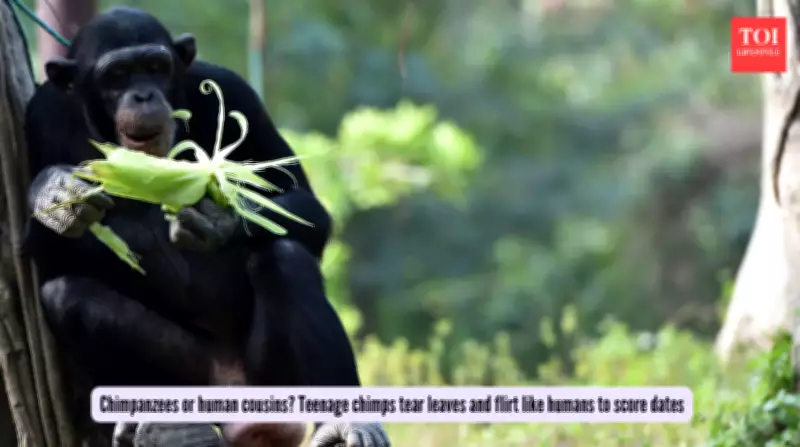
Chimpanzees Use Leaf-Tearing as Flirting Technique, Echoing Human Teen Behavior
Chimpanzees, humanity's closest primate relatives, continue to astonish scientists with behaviors that mirror our own in unexpected ways. From sophisticated tool use to complex social dynamics, their actions offer profound insights into the evolutionary origins of human habits. A particularly fascinating discovery involves their courtship rituals, where adolescent chimps engage in leaf-tearing to flirt, reminiscent of the awkward, high-stakes dating games played by human teenagers.
Leaf-Tearing as a Chimpanzee "Pick-Up Line"
Professor Cat Hobaiter from the University of St Andrews, with over two decades of experience studying primate gestures, has identified this behavior as a form of chimp flirting. At the American Association for the Advancement of Science conference in Phoenix, Arizona, she described it as "basically chimp flirting. It's like a chimp pick-up line, you tear a little leaf at someone to show you like them." This observation, covered by the Daily Mail, highlights how chimps use environmental objects to communicate romantic interest.
The behavior primarily involves males targeting females in estrus, though it is not exclusive to them. "You certainly get some females who will use it," Hobaiter noted, drawing a parallel to human social dynamics. "It's almost like when teenage girls are trying to work out how to get attention." The distinct ripping sound produced by tearing leaves can carry over distances, effectively grabbing the notice of potential mates in their social group.

Variations in Flirting Styles: Loud vs. Quiet Approaches
Not all chimps flirt in the same manner. Some individuals produce loud, audible leaf-tears to announce their intentions boldly, while others adopt a more subtle approach. Hobaiter explained that quiet plucking resembles "plucking daisy petals... 'She loves me, she loves me not'." This quieter method may serve strategic purposes, such as avoiding detection by rivals. "Maybe you don't want to give the game away to the big guy around the corner that might out-compete you," she added, underscoring the competitive aspects of chimp courtship.
A study published in Scientific Reports, conducted by Hobaiter's team in Uganda, analyzed two neighboring East African chimpanzee communities. The research confirmed that "across communities, this behavior primarily occurs in sexual contexts and is argued to function as a courtship behavior to solicit copulations, particularly by young males toward females in oestrus." Interestingly, the study revealed cultural variations: one group preferred mouth-ripping "leaf-clip" gestures, while the other used twig-pulling "leaf tear-pull" techniques. These differences suggest that, at least in part, the behaviors are socially learned and transmitted within communities.
Broader Implications: Chimpanzee Gestures and Human Parallels
Leaf-tearing is just one example of the approximately 150 decoded chimpanzee gestures that closely mirror human communication. For instance, a palm-out reach translates to "gimme," a shooing motion means "go away," and a hand nudge signals "budge up." Other gestures include loud scratches to initiate grooming, spins to indicate "stop that," and arm raises to suggest "let's move." These shared behaviors underscore the deep evolutionary connections between humans and chimpanzees, providing valuable clues about the development of social and communicative skills in primates.
The discovery of leaf-tearing as a flirting technique not only enriches our understanding of chimpanzee social lives but also prompts reflection on the universality of certain behaviors across species. As researchers continue to decode primate gestures, each finding brings us closer to unraveling the complex tapestry of evolutionary history that binds humans to their closest living relatives.