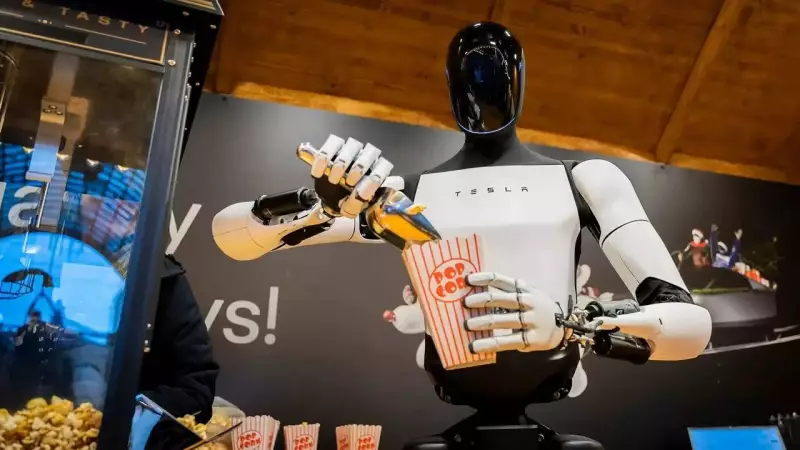
In a significant shift in the global technology race, Chinese companies are now positioned to outpace Tesla in the large-scale manufacturing of humanoid robots. Industry experts predict that several firms in China will begin ramping up production as early as 2026, potentially seizing a first-mover advantage in a market projected to be worth trillions of dollars.
The Strategic Push Behind China's Robotics Dominance
This development comes despite Tesla CEO Elon Musk positioning the company's Optimus humanoid robot as central to its future valuation, which he believes could reach tens of trillions. However, Tesla has yet to sell its flagship robot. Meanwhile, Beijing has strategically placed humanoid robot technology at the core of its national plans, providing Chinese companies with a substantial policy and supply chain advantage.
"China currently leads the United States in the early commercialisation of humanoid robots," stated Andreas Brauchle, a partner at consultancy Horváth, in an email to CNBC. He noted that while both nations are expected to build large markets eventually, China is scaling more rapidly in this initial phase.

Addressing Demographics and Tech Leadership
China's aggressive push is driven by multiple critical factors. The country faces a declining birth rate and an ageing population, which is shrinking the workforce and increasing labour costs. Humanoid robots are seen as a vital solution to these demographic pressures.
"China's push into humanoid robotics development is driven by a combination of addressing demographic pressures, driving the next horizon of economic growth, and strengthening its role in global competition," explained Karel Eloot, a senior partner at McKinsey & Company. This ambition was formalised in October when Chinese President Xi Jinping and top leaders released proposals for the country's next five-year plan, highlighting 'embodied artificial intelligence'—a term encompassing AI-driven hardware like robots.
A New Tech Battleground and a Massive Market
The robotics sector is emerging as a new front in the broader US-China tech rivalry. Reports indicate that Washington is considering an executive order on robotics next year to accelerate its industry. Analysts at RBC Capital Markets forecast a global humanoid robot market worth $9 trillion by 2050, with China accounting for more than 60% of that staggering figure.
On the ground, Chinese companies are advancing swiftly. Firms like Unitree, which is preparing for an IPO that could value it at around $7 billion, are leading the charge towards mass production. These AI-powered robots, designed to mimic human shape and movement, are envisioned for use in factories, hospitality, and even homes.
As the 2026 timeline approaches, the race to commercialise humanoid robots is intensifying. With strong state backing, clear economic incentives, and rapid scaling capabilities, China appears to have built a formidable lead, setting the stage for a transformative shift in both global manufacturing and the balance of technological power.