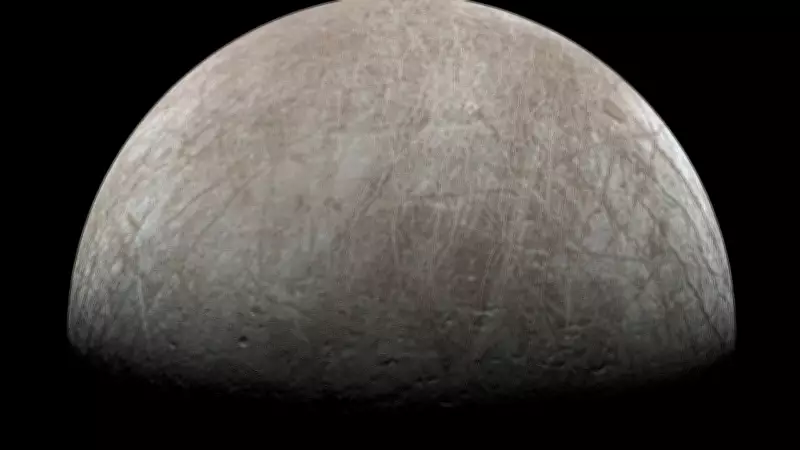
Europa has long occupied a special place in discussions about extraterrestrial life. Beneath its fractured shell of ice lies a global ocean that may contain more water than all of Earth's seas combined. For decades, scientists have wondered whether that hidden ocean could support living organisms.
Most theories begin with the assumption that any life on Europa would have emerged there independently. A different possibility asks a stranger question: What if some of the ingredients for life, or even microscopic life itself, did not originate on Europa at all? What if they came from Earth?
According to the study, published in Scientific Research, titled “The Possibility for Panspermia in the Galaxy by Means of Planetary Dust Grains”, it examines whether tiny dust grains escaping Earth's atmosphere could have travelled across the Solar System and eventually reached Europa. The idea falls within the broader concept of panspermia, the hypothesis that life can spread naturally between worlds. While the scenario remains speculative, the calculations suggest that Earth and Europa may not have been as isolated from one another as they seem.

How dust grains could carry life from Earth into the Solar System
The journey begins surprisingly close to home. According to the study, microscopic dust particles high in Earth's atmosphere can collide with incoming cosmic dust. Under particular conditions, those impacts may accelerate some particles to speeds greater than Earth's escape velocity. Once free from the planet's gravitational pull, they become travellers of the Solar System.
These grains are extraordinarily small, yet they could potentially carry bacteria or complex organic molecules. The research focuses on particles capable of avoiding excessive heating during escape, since high temperatures would destroy any biological material they contained. If they survive this first stage, sunlight itself becomes an ally. Radiation pressure from the Sun can gradually push the particles farther from Earth and into interplanetary space.
The process is not dramatic. There are no violent launches or spectacular explosions. Just tiny grains slowly drifting outward over time.
How microscopic particles could travel from Earth to Europa
The possibility becomes more intriguing when Jupiter enters the picture. The calculations suggest that dust particles originating from Earth could eventually cross the orbit of Jupiter. Once they enter the giant planet's gravitational sphere of influence, their trajectories may be altered in ways that allow some of them to intersect with Europa.
The odds for any single particle are extremely small. Most would never come close to the icy moon. Many others would be destroyed or diverted elsewhere. Yet the sheer number of particles potentially leaving Earth changes the scale of the problem.
Over geological timescales, even tiny probabilities can accumulate into significant numbers. The study argues that if Earth has been releasing dust grains for billions of years, a continual stream of material may have reached distant parts of the Solar System. In principle, some of that material could include microorganisms protected within microscopic dust mantles or fragments of biologically important molecules.
The survival problem in the Earth-to-Europa theory
Getting to Europa is only part of the story. Space is an unforgiving environment. Ultraviolet radiation, energetic particles and prolonged exposure to vacuum all pose serious threats to living organisms. The paper spends considerable attention examining these hazards and concludes that survival is far from guaranteed.
Unshielded bacteria would quickly accumulate damaging radiation doses. Larger dust grains offer better protection, extending survival times and allowing biological material to travel much greater distances. Even so, the research acknowledges major uncertainties. Scientists still do not fully understand how microorganisms would respond to millions of years in space or repeated exposure to harsh radiation environments.
There is also the question of arrival. Reaching Europa's surface would not automatically place life inside its ocean. Any incoming material would first encounter a frozen crust that may be many kilometres thick.

Yet Europa's ice is not static. Observations indicate a dynamic surface shaped by fractures, shifting ice and exchanges between the surface and deeper layers. If biological material survived the journey and reached regions where surface material eventually moves downward, a pathway to the subsurface ocean cannot be entirely ruled out.
What could this mean for the search for life on Europa
The study does not claim that Europa contains Earth life. Nor does it suggest that life has definitely travelled between the two worlds. Instead, it explores whether the laws of physics allow such a transfer to happen at all.
The answer appears to be that nature may provide a mechanism, however inefficient. Tiny dust grains can escape planets, travel vast distances and potentially carry complex chemistry with them. Whether they transport living organisms successfully remains an open question.
If future missions eventually discover life in Europa's hidden ocean, scientists will face another challenge beyond proving that life exists there. They may need to determine where it came from.
The possibility that some distant microbial ancestor once began its journey in Earth's upper atmosphere, carried away on a grain of dust, remains speculative. Yet it is a reminder that the Solar System may be more interconnected than it appears, with microscopic travellers quietly crossing the darkness between worlds.