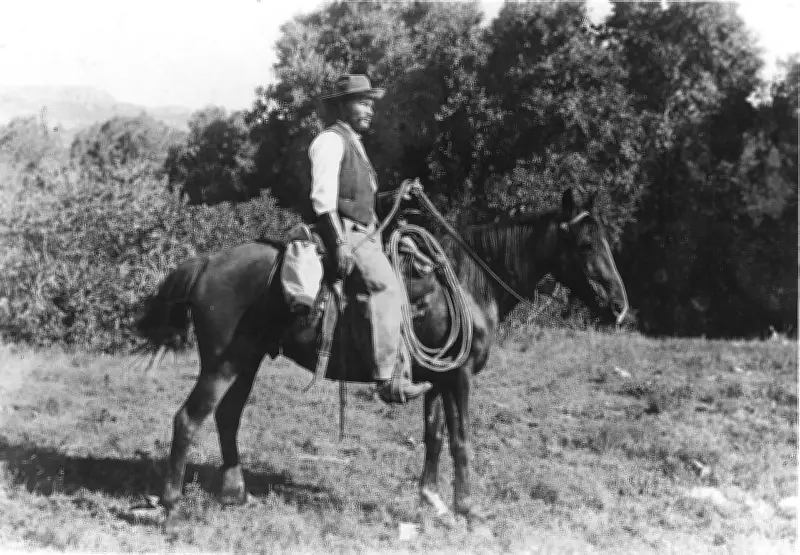
History is not always uncovered in dusty libraries by academics; sometimes, it emerges through those who can interpret the landscape. On a sweltering August afternoon in 1908, a massive flash flood devastated the Wild Horse Arroyo near Folsom, New Mexico. The torrent was so powerful that it eroded the soil, stripping away layers of sediment built up over centuries. After the mud dried, George McJunkin, an experienced rancher and foreman at the Crowfoot Ranch, rode out to inspect the fence lines.
McJunkin was no ordinary ranch hand. He had taught himself to study nature and understand its subtle mysteries. He noticed bleached white bones, larger than any he had seen before—even bigger than those of cattle or buffalo. Most people would have walked away, but McJunkin sensed that these bones were buried deep enough to reveal something profound about prehistoric times. He collected samples and spent years trying to persuade experts to examine them, unaware that he held the key to unlocking the secrets of America's first peoples.
The Spear Point That Changed Everything
Nearly two decades later, the scientific community confirmed McJunkin's suspicions. In the early 1920s, archaeological digs unearthed definitive proof that humans lived in America during the Ice Age. Embedded in the ribcage of a long-extinct bison was a spear made of stone. This discovery at the Folsom site was groundbreaking. According to a study by the University of Texas at El Paso, it was the first archaeological site to prove without doubt that humans coexisted with Ice Age mammals.

Previously, evidence for human existence in North America thousands of years ago was scarce. The Folsom findings showed that people had been present for about 10,000 to 13,000 years, effectively doubling the known timeline of human habitation in the Western Hemisphere. A rancher's keen eye in 1908 New Mexico had unearthed ancient bones, revealing a truth that would rewrite history.
Specialized Hunting Culture of the Ice Age Hunters
The Folsom site not only demonstrated prolonged human existence but also revealed a remarkable culture. These early Americans were not merely focused on survival; they were skilled artisans who produced sophisticated tools, such as the famous Folsom points. These delicate artifacts feature a central groove, believed to help secure the points to wooden spear shafts. The specialized nature of these tools is explored in the National Park Service's study on Paleo and Archaic Cultures. It highlights how the Folsom people transitioned from hunting mammoths to focusing almost exclusively on a giant, now-extinct species of bison called Bison antiquus. These animals were significantly larger than modern bison, and hunting them required incredible coordination and specialized gear. The Folsom site showed that these early Americans had a deep understanding of animal behavior and seasonal migration, allowing them to thrive in a landscape still affected by the tail end of the last Ice Age.
George McJunkin did not live to see the full impact of his discovery, but his name is now found in all history books about the first Americans. His story proves that knowledge, curiosity, and common sense within a community can be as important as academic credentials in uncovering the truth. A cowboy's decision to investigate a ditch helped us learn more about America's ancient past than we ever thought possible.