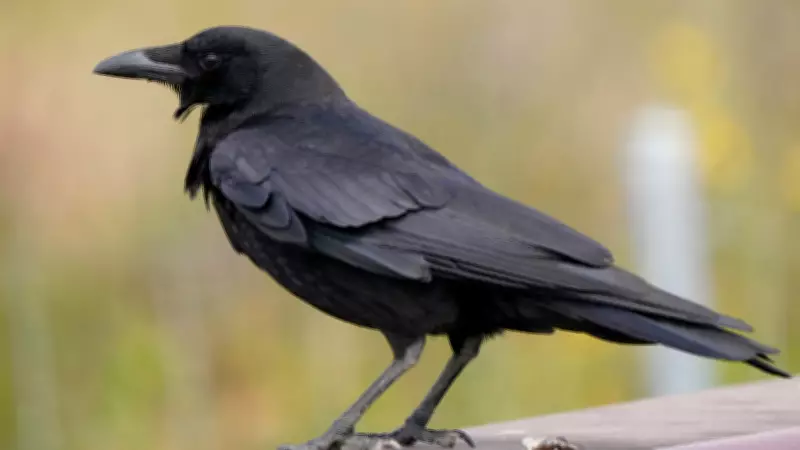
Most people think of crows as noisy black birds gathering in trees or scavenging for food. Science, however, paints a far more remarkable picture. These extremely smart animals can actually recognise human faces individually, have good memories about pleasant and unpleasant experiences with specific individuals, and even share knowledge with other crows regarding certain dangerous humans. The intelligence of these animals has amazed the scientific community for ages and has shown that such features as having good memories were exclusive only to primates. What makes these birds even more interesting is the term used when describing groups of these birds; it is called "a murder of crows." The meaning of this term sounds menacing; however, its origin relates to medieval times and mythology.
How crows identify people and remember them for years
The most influential research on crow facial recognition comes from Professor John Marzluff and colleagues at the University of Washington. Their studies demonstrated that crows can distinguish between individual human faces and retain those memories for years.
In a landmark study published in the Proceedings of the National Academy of Sciences, titled 'Brain imaging reveals neuronal circuitry underlying the crow's perception of human faces,' researchers found that crows could remember specific faces associated with threatening experiences and alter their behaviour accordingly. The study states that crows "can remember specific faces for several years after a single encounter." Researchers wore distinctive masks while capturing and banding wild crows. Years later, birds continued to scold and mob people wearing the same "dangerous" masks, despite never being directly harmed again. Even more striking was the observation that younger birds, which had never witnessed the original event, also reacted aggressively, suggesting social transmission of information within crow communities.

According to Marzluff: "Cross a crow, and it'll remember you for years." Brain imaging conducted during the research revealed that crows activate specialised neural regions associated with perception, emotion, learning and memory when viewing familiar human faces. Scientists concluded that crows integrate visual recognition with emotional responses in ways that parallel mechanisms seen in mammals.
What crow intelligence reveals about animal memory and social learning
Facial recognition is only one part of a broader suite of cognitive abilities found in corvids, the bird family that includes crows, ravens and magpies. The University of Washington research showed that crows do not merely react instinctively. They evaluate, categorise and remember individuals based on previous experiences. Brain scans indicated activation of regions linked to fear, attention and behavioural decision-making when crows viewed threatening faces.
Scientists believe these abilities help crows survive in complex urban and natural environments where recognising threats can mean the difference between life and death. Their capacity to share information across generations further demonstrates sophisticated social learning rarely documented in wild birds. This growing body of evidence has transformed scientific understanding of avian intelligence, placing crows among the most cognitively advanced non-human animals studied to date.
Why a group of crows is called a murder and the medieval story behind it
Even though scientific facts support crow intelligence, the term "murder of crows" is part of an old tradition. Firstly, "murder of crows" is not a scientific denomination at all. On the contrary, this term belongs to a set of collective animal names that arose in the medieval times of the English language. This is why historians consider "murder of crows" to be derived from folk tales that link crows to death. According to Ornithology.com, crows fed on dead bodies quite often and used to gather near the places of battles and executions. Thus, their black colouring, sharp voice, and eating manner made these birds a symbol of death in European folklore. Therefore, the dramatic collective animal term arose. However, despite the somewhat sinister name of the crow group, scientists tend to use neutral terms like "flock."