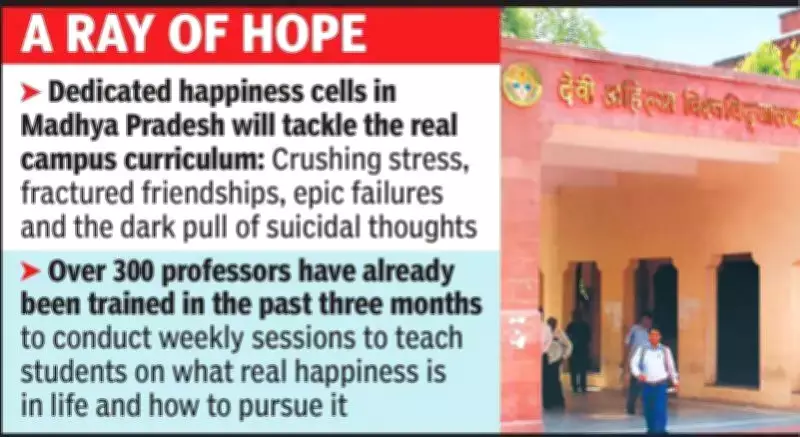
Indore: Once projected as a model initiative, Devi Ahilya Vishwavidyalaya's (DAVV) Anand Cell, the state's first happiness cell established in 2016, has slipped into near inactivity after a brief phase of early engagement. This decline raises concern over the continuity of well-being initiatives in higher education institutions.
Background of the Anand Cell
Launched in line with the Madhya Pradesh government's Anand Department, the cell was conceived to promote inner well-being alongside academic growth. The initiative recognized that material progress alone does not ensure a fulfilling life. In its early phase at DAVV, the cell organized seminars, symposiums, and a three-day workshop titled 'Crafting Career with Happiness' for students of university teaching departments. These programs aimed to introduce students to balanced living, self-awareness, and emotional resilience.
Initial Support and Activities
The cell at the university was set up as part of a state-wide initiative that brought several universities and institutions under its fold to promote well-being. Initially, it was supported by a team of five to six members tasked with carrying forward its activities. However, the momentum could not be sustained, university officials indicated.

"With a few programs in the beginning, the activities gradually faded out, especially after the pandemic and the retirement of the in-charge," said retired Professor Maya Ingle, a former member of the Anand Cell. She noted that while initial sessions on health and well-being drew participation, the initiative lacked continuity in later years.
State Government's Renewed Focus
Recently, the state government planned to introduce happiness cells across all government colleges. Led by Rajya Anand Sansthan, the move aims to address increasing stress levels among students and create structured platforms for emotional support. Over 300 professors have already been trained to conduct weekly sessions focusing on life skills, harmony, and coping with academic pressure.
Lessons from DAVV's Experience
At a time when the state government is moving ahead with plans to introduce happiness cells across all government colleges, experts point out that the experience at DAVV highlights the difficulty of sustaining such initiatives at the institutional level. They stress that without consistent leadership, regular activities, and oversight, such efforts risk losing relevance over time.
Members associated with the DAVV Anand Cell believe the initiative still holds relevance and must be revived. "There is a clear need to restart such platforms. Students as well as teachers face considerable stress, and structured initiatives like the Anand Cell can help create a more supportive academic environment," said Yamini Karmarkar, a member of the cell.
Plans for Revival
Indicating that there are plans to revive and restructure the initiative, Vice-Chancellor R.K. Singhai told TOI, "We have been working to develop the cell into a wellness centre, though the process is still underway. With the state government now placing renewed focus on this initiative, we will restart the cell for the benefit of students."
The experience at DAVV serves as a cautionary tale for the state's broader happiness cell initiative, emphasizing the need for sustained commitment and resources to ensure long-term success.