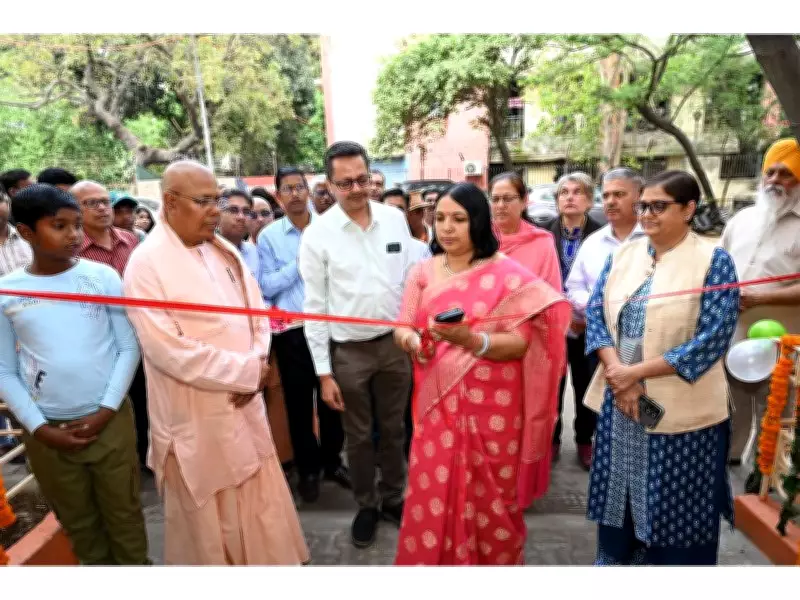
Century-Old Ashram Launches Delhi's First Public AI Lab, Democratizing Tech Access
In a groundbreaking move, a century-old spiritual institution has transformed into a hub of modern technology, opening Delhi's newest artificial intelligence and robotics laboratory. This facility, inaugurated on March 15, 2026, is dedicated to bridging the digital divide by providing free, hands-on AI education to all citizens, regardless of their prior experience or socioeconomic status.
Inauguration by Government Dignitaries
The Swami Pranavananda AI & Robotics Lab was officially launched at the Bharat Sevashram Sangha in Sriniwaspuri, South Delhi. The ceremony was graced by Smt. Nidhi Khare IAS, Secretary of the Department of Consumer Affairs, Government of India, who emphasized the lab's role in building a future where AI literacy is as fundamental as reading and writing. Other distinguished guests included Ms. Nisha Damor IAS, Additional Collector from Indore, Madhya Pradesh; Capt. (Dr.) Indu Boken Kasana, District Education Officer from Gurugram, Haryana; and Swamy Atmajnanananda Ji Maharaj, Secretary of the Delhi branch of Bharat Sevashram Sangha.
Volunteer-Driven Initiative
This innovative project is part of the Bharat Tech-Shakti Mission, spearheaded by three dedicated volunteers: Basab Dasgupta, Dhirender Saini, and Aditya Sen. These working professionals conceptualized, planned, and constructed the lab entirely in their personal time, without drawing any salary or benefits. Their mission, encapsulated in the tagline Srijan Se Shakti (strength through creation), is to empower the community by providing access to cutting-edge AI skills that are often out of reach for many Indians.

Comprehensive Curriculum
The lab's curriculum is meticulously designed to cover the most relevant AI skills today. It includes:
- Text generation and image creation using advanced AI tools.
- Building voice-controlled applications and conducting computer vision experiments.
- Utilizing platforms like Google Teachable Machine to understand machine learning from data.
- An advanced track focusing on model training, IoT-enabled smart device control with Raspberry Pi and Arduino, and real-world application development through APIs.
A unique feature is vibe coding, which teaches learners to describe their requirements in plain language, allowing AI to generate the code. This approach has the potential to democratize software creation, making it accessible even to those without a programming background.
Ethical AI and Infrastructure
Responsible AI use is integrated into every aspect of the training. Learners are educated not only on the capabilities of AI but also on its limitations, ethical considerations, and how to verify outputs. The lab boasts a production-grade learning environment equipped with:
- Five high-performance desktop workstations.
- A 65-inch EDLA-certified interactive smart board.
- Raspberry Pi computers and a complete Arduino sensor kit.
- An Alexa Echo Dot connected to IoT-enabled smart devices.
- UPS support and fibre broadband with WiFi coverage.
Inclusive Access for All
The lab is open to everyone with no entrance tests, age limits, or prerequisites. It offers three tailored tracks:
- Beginner: For individuals starting from scratch, including first-time computer users.
- Intermediate: For those with basic computer knowledge seeking deeper insights into data analysis and hardware.
- Advanced: For programming enthusiasts interested in model behavior, IoT, and API applications.
This inclusivity ensures that a Class 5 student and a 55-year-old novice can both find a suitable starting point on the same day.
Remarks from the Inauguration
Smt. Nidhi Khare highlighted, "AI is no longer a tool only for the technologist. It is fast becoming as fundamental as reading and writing. An initiative that teaches a first-generation learner to use these tools is not just building a skill—it is building a future."

Swamy Atmajnanananda Ji Maharaj reflected on the ashram's legacy, stating, "Swami Pranavananda taught us that true seva is giving people the power to stand on their own feet. Every technology has transformed the world in its time. Today that technology is AI. This lab carries forward the Sangha's founding purpose in the language of our era."
Ms. Nisha Damor added, "Artificial intelligence must not become another wall that separates the privileged from the rest. Initiatives like this lab are about tearing that wall down—one learner at a time. When a girl from a modest household walks into this lab and builds something with AI, she is not just learning a skill—she is rewriting what is possible for herself and every woman who follows her."
Capt. (Dr.) Indu Boken Kasana emphasized the educational impact, noting, "Students today are growing up in a world where AI will decide who gets a job interview and who does not. A school student who understands how these tools work has a head start that no textbook can give them. Initiatives like this should exist in every district of India."
Future Prospects
Demo classes are scheduled to commence the week of March 21, 2026. For enrollment and further details, interested individuals can contact the lab directly at Swami Pranavananda Marg, Sriniwaspuri, New Delhi. This initiative represents a significant step towards making AI education accessible and inclusive, fostering a generation of creators rather than mere consumers of technology.