Necessity is the mother of invention, and when topped with creativity, it leads to greatness. While some people escape the heat by switching on air conditioners or coolers, others must rely on hand fans. This disparity in affordability and accessibility makes summer a season that some love and others dread.
Turning Compassion into Creativity
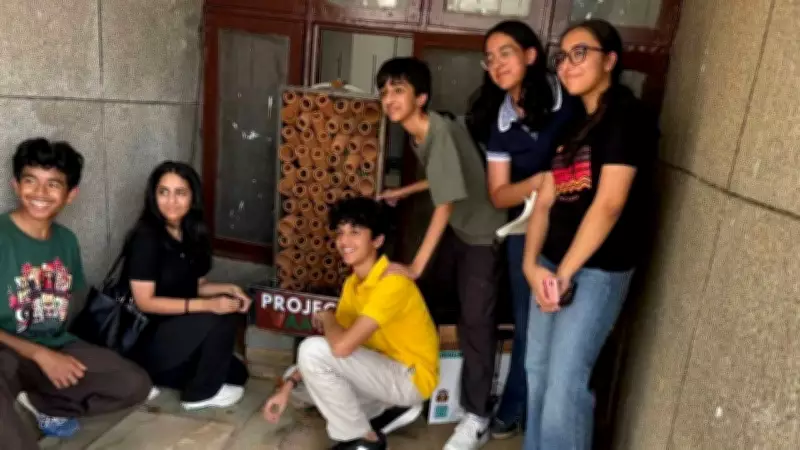
To make a difference and help those in need, six students from Delhi's The Shri Ram School, Moulsari, used kulhads (clay tea cups), scrap wood, and metal to transform compassion into creativity. They created cool, breathable classrooms for underprivileged students in government schools. Their initiative, Project Vaayu, merges traditional wisdom with modern design to produce low-cost, sustainable coolers.
Harish, a Class 5 student from a government school in Delhi's V Block, said, "Earlier, I used to feel hot. Now, after this cooler has been installed, it feels nice. I can even focus on my studies."

The Inspiration Behind Project Vaayu
In April 2024, when Delhi endured temperatures near 50 degrees Celsius, even air-conditioned classrooms felt unbearable. "We were struggling to focus despite all our privileges," recalled project leader Amaira Kapoor. "We wondered how government school students without fans or cooling systems were coping."
The team, including Amaira, Kartikeya Shastri, Zoey Singh, Shayan Sethi, Jovika Nagpal, and Nevan Roy, visited a nearby government school. There, they found students sitting in cramped concrete classrooms under tin roofs, sweating through lessons. "That visit changed everything," said Amaira. The issue was no longer just about heat; it was about equity and empathy.
All Hands on Deck
Determined to act, the students brainstormed solutions that were eco-friendly, affordable, and low-power-consuming. They were reminded of the age-old practice of evaporative cooling. "When we explain it in Hindi, people immediately connect it to matkas, the clay pots that keep water cool," Amaira noted. "That's when they ask, 'Why isn't this everywhere already?'"
How the Eco-Coolers Work
The coolers use recycled kulhads arranged in a wooden frame and reinforced with scrap metal. Water flows over the porous cups, which absorb and slowly release it through evaporation. This naturally cools the air constantly, with the help of a small water pump, while silica gel seals prevent leakage. These eco-coolers reduce classroom temperatures by 6-10 degrees Celsius, making a real difference.
The coolers were assembled by the students in their homes and backyards, not in high-tech labs. They sourced everything from kabadiwalas (scrap dealers), while families and volunteers joined in to help, along with a local technician. "We constructed everything ourselves," said Zoey Singh. "It was all trial, error, and learning."
Award and Expansion
The team won the second prize at the 'Youth for Earth' competition, organized by the Climate Reality Project and Mobius Foundation. The cash prize helped strengthen their mission. In September 2024, the first cooler was installed in a government primary school classroom. By May 2025, five coolers were operating across four schools, benefiting over 400 students. Data collected from these classrooms confirmed a significant temperature drop and a dramatically improved learning environment.
Parveen, Principal at the V Block school, affirmed, "The cooler has brought down the temperature by a few degrees. Students feel happier, and a more comfortable environment encourages attendance."
Role Models for Sustainability
The students have become role models for their juniors, who are learning the importance of sustainability and community service. The team's immediate goal is to install five more coolers and reach 1,000 students. "We've proven this works. Now, we want to take it further," Zoey says. They also hope to expand to other community spaces, such as government hospitals, animal shelters, and rural learning centers.
"We're told young people are the future. But we can be part of the present too. Change doesn't need perfection; it starts with a single observation, a local problem, or one school," added Amaira.