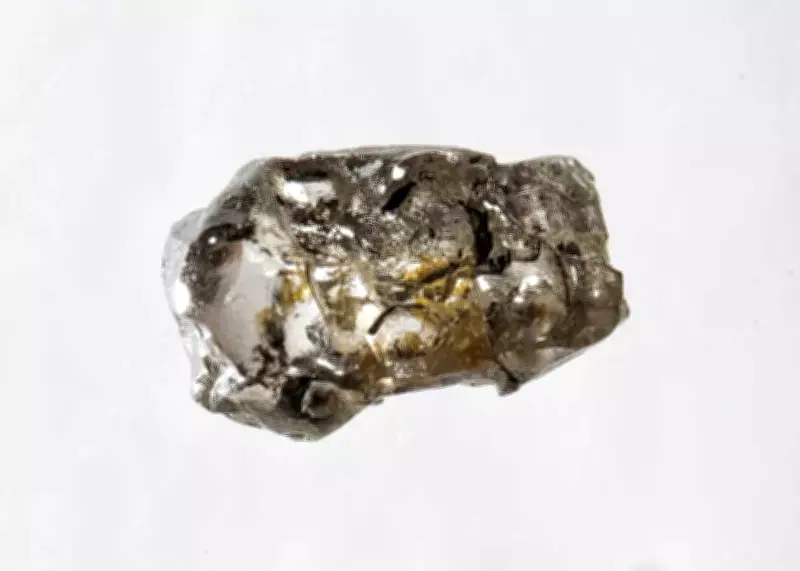
Diamonds are renowned for their external brilliance, but their true scientific value often lies concealed within. A diamond sourced from Juína, Brazil, has significantly advanced our understanding of Earth's deep interior. When researchers crushed the diamond specimen, they discovered a microscopic blue speck that served as a natural time capsule from the deep Earth.
Ringwoodite: A Unique Mineral from the Deep Mantle
This inclusion was identified as ringwoodite, a high-pressure polymorph of olivine that forms only under the immense pressures of Earth's deep mantle. This marked the first time ringwoodite was found in a natural terrestrial sample rather than in a meteorite. Encased within the diamond, the mineral retained its high-pressure structure as it was transported to the surface.
Evidence of Water in the Mantle Transition Zone
Further analysis revealed that the ringwoodite contained structurally bound water, indicating the presence of water deep beneath Earth's solid crust. A 2014 study published in Nature titled "Hydrous mantle transition zone indicated by ringwoodite included within diamond" detailed these findings. An international team of mineral experts combined X-ray diffraction and laser spectroscopy to examine the inclusion without destroying it.

The Gemological Institute of America later noted that the blue inclusion measured only 30 micrometers wide. Despite its minuscule size, the diamond matrix prevented the mineral from expanding as it rose, preserving its high-pressure form. This natural protection allowed scientists to study an otherwise inaccessible layer of Earth's interior.
Infrared absorption testing revealed a water-rich signal, confirming that the sample contained about one percent water by weight, structurally bound within the crystal lattice. Although one percent seems small, the detection suggests that the mantle transition zone, located 410 to 660 kilometers below the surface, can store significant amounts of water locked in rock minerals.
Implications for Earth's Water Cycle
This discovery moves scientists beyond theoretical computer models, providing concrete evidence that the mantle transition zone can hold structurally bound moisture. It is important to note that this does not imply underground oceans or liquid water; the water is integrated into the mineral's crystal structure. However, given the vastness of the transition zone, even a small percentage of water represents a substantial volume hidden deep underground.
While a single microscopic sample cannot confirm uniform wetness throughout Earth's interior, it offers a crucial benchmark for research into how our planet retains and cycles elements. The crushed Brazilian diamond demonstrates that parts of the deep Earth can store water within minerals and transport it over geological timescales. This tiny blue speck has provided a remarkably clear window into the hidden mechanics of our planet.