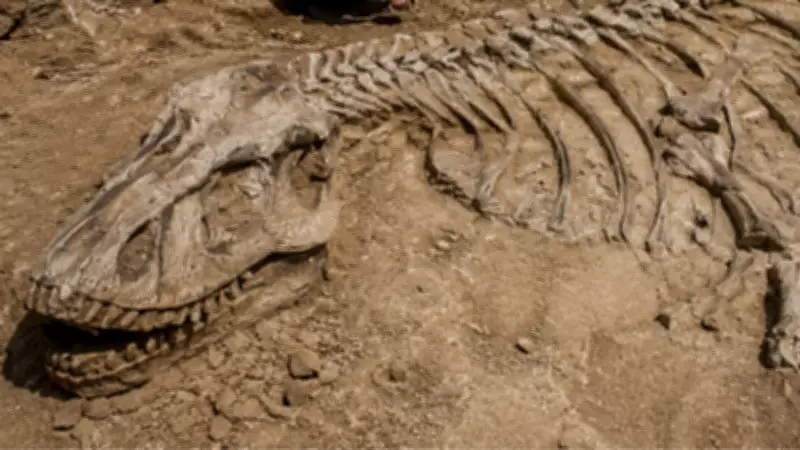
What began as an ordinary walk with a dog through the countryside of southern France turned into one of the country's most remarkable dinosaur discoveries in recent years. In 2022, French palaeontology enthusiast Damien Boschetto was walking near the village of Montouliers in the Hérault region when he noticed strange bones protruding from a cliffside near a forested area. Curious about the unusual shapes embedded in the rock, he alerted scientists, who later excavated the site and uncovered the remains of a giant titanosaur dinosaur dating back roughly 70 million years. Researchers described the skeleton as one of the most significant dinosaur fossil discoveries made in France in decades.
How a Dog Walk Discovered the Dinosaur Fossil Site
The discovery happened near Montouliers, a small village in southern France known for fossil-rich geological terrain. Boschetto, who has a long-standing interest in palaeontology, was out walking his dog when he noticed what appeared to be large bones emerging from exposed sediment along a cliffside. At first, the shapes looked unusual but not necessarily extraordinary. However, Boschetto suspected they might be fossils and contacted palaeontologists for further examination. Scientists later visited the location and confirmed that the remains belonged to a prehistoric dinosaur buried underground for millions of years. The site soon attracted researchers because of the scale and condition of the fossils preserved within the rock layers.
After excavation began, researchers discovered that the bones belonged to a titanosaur, a group of enormous long-necked herbivorous dinosaurs that lived during the Late Cretaceous period. Scientists estimated that the dinosaur lived around 70 million years ago, near the end of the age of dinosaurs before the asteroid impact that triggered the mass extinction event. According to researchers involved in the excavation, the skeleton was approximately 70% complete, an unusually high level of preservation for a dinosaur fossil of this size. That made the discovery especially valuable because complete or near-complete titanosaur skeletons are relatively rare in Europe. The fossil remains included large vertebrae, limb bones and other skeletal elements preserved beneath layers of sediment.

The Importance of the Discovery
Titanosaurs were among the largest animals ever to walk the Earth. Some species grew more than 30 metres long and weighed tens of tonnes. Fossils of these dinosaurs have been discovered in South America, Africa, Asia and Europe, helping scientists understand how dinosaur populations spread across ancient continents. Researchers say the Montouliers discovery could provide new information about dinosaur evolution and prehistoric ecosystems in what is now southern France. The fossil site may also help scientists better understand the environment that existed in Europe during the Late Cretaceous period, when much of the continent consisted of islands surrounded by shallow seas. Because the skeleton remained relatively intact, researchers have a rare opportunity to study how the animal's bones were arranged and preserved over millions of years.

France Has a Long History of Important Dinosaur Discoveries
France has become increasingly important in European dinosaur research over the past few decades. Numerous fossil discoveries in southern France have revealed evidence of titanosaurs, predatory dinosaurs and dinosaur nesting grounds. The region's geology preserves large areas of Late Cretaceous rock, making it one of the most valuable fossil-hunting areas in Europe. Palaeontologists often monitor cliffsides, riverbanks and erosion-prone landscapes in these regions because shifting sediment can expose previously hidden fossils unexpectedly. Many major fossil discoveries begin with ordinary people noticing unusual shapes in rocks or soil. Farmers, hikers, fossil enthusiasts and construction workers have all contributed to important palaeontological finds around the world. Erosion caused by rain, wind and shifting landscapes constantly exposes ancient remains buried underground. Scientists say discoveries like the one made by Boschetto highlight how chance still plays a major role in palaeontology. Without that casual dog walk and Boschetto's curiosity about the exposed bones, the giant dinosaur may have remained hidden beneath the cliffs of southern France for millions more years.