

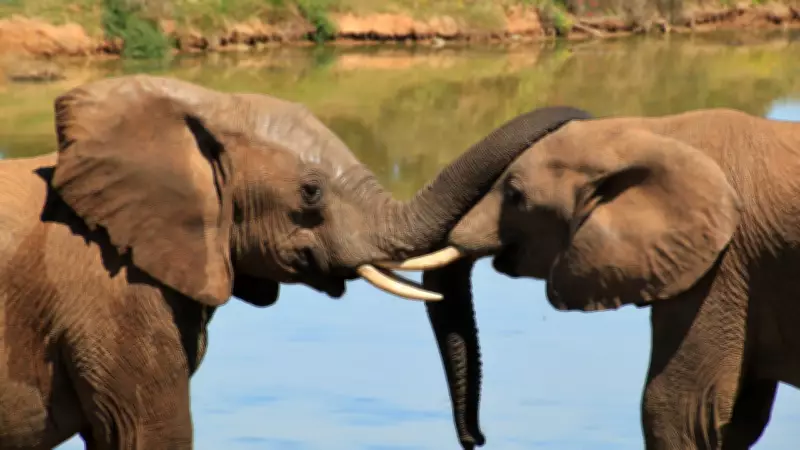
Elephants are well-known for their excellent memory capabilities, social intelligence, and facial recognition skills. However, recent research shows even more fascinating facts about these animals, as scientists believe they use individual-specific vocal labels, which can be called 'names,' to recognize and communicate with each other.
Elephant Communication and Social Intelligence
Elephant communication is already understood quite well, thanks to studies on African elephants whose calls may serve as an equivalent of human names, thus creating closer ties between group members. Studying how elephants communicate and label specific individuals provides further insight into their cognitive abilities and social life.
It is widely known that elephants have highly sophisticated social structures. Their communication involves vocalizations, body postures, and physical touches. The rumbles that elephants make can travel over great distances, up to several kilometers.

Scientists state that, contrary to popular belief, there is a structure to the vocalizations made by these mammals. According to the paper 'Knowledge transmission, culture and the consequences of social disruption in wild elephants,' elephants use learned vocal labels for addressing other members of their group. Such an observation proves that elephant communication is quite developed.
Do Elephants Really Use 'Names' for Each Other?
The concept of elephants having 'names' was developed through the analysis of their responses to calls. In the research paper 'African elephants address one another with individually specific name-like calls,' researchers found that elephants exhibited greater sensitivity to calls perceived as being uniquely addressed to them than to calls made in the general context of herd calls.
Machine learning models were employed by researchers to determine whether specific patterns in elephant calls could identify individuals. It was found that individual calls had a higher correlation with the identity of elephants than random probability.
Michael Pardo remarked during the study: 'Contrary to mimicry-based naming systems, it looks like elephants do not echo the call of the receiver. The call itself is arbitrary.' This is important because it is similar to naming conventions among humans, where names are arbitrary assignments and not mimicry.
Memory, Relationships, and Identity in Elephants
Elephants have already been celebrated for their memories, especially when recognizing people after prolonged periods of separation. The new findings suggest that memory and vocalization could be strongly related. Elephant societies rely on teamwork, strong associations, and synchronized movement. A 'calling' system would definitely facilitate better coordination within the herd.
The Amboseli Elephant Research Project, one of the longest-running elephant research projects, has established that elephants can sustain lifelong associations. The project's director, Cynthia Moss, has described: 'Elephants lead socially complex lives, with family associations lasting many years.' Vocal labeling would be a natural way of doing so.
What This Means for Animal Cognition and Language Evolution
The fact that elephants could potentially communicate via naming has changed the way we view animal intelligence. The idea that symbolic language is unique to humans could very well be wrong, since elephants, among other animals, might have evolved an independent form of such communication. This discovery has also shed light on the development of human language. If elephants use labels, this would mean that certain social pressures allowed for a naming system to emerge at least twice independently, or even once, prior to humans developing language as we know it today.
As the scientists write in their paper: 'This ability may be an important feature of complex social cognition.' While elephants have always been known for their great memory, there might be much more to them than that. Recognizing each other based on vocal labels is a skill that shows elephants' intelligence and even their emotional world beyond what we ever suspected.






