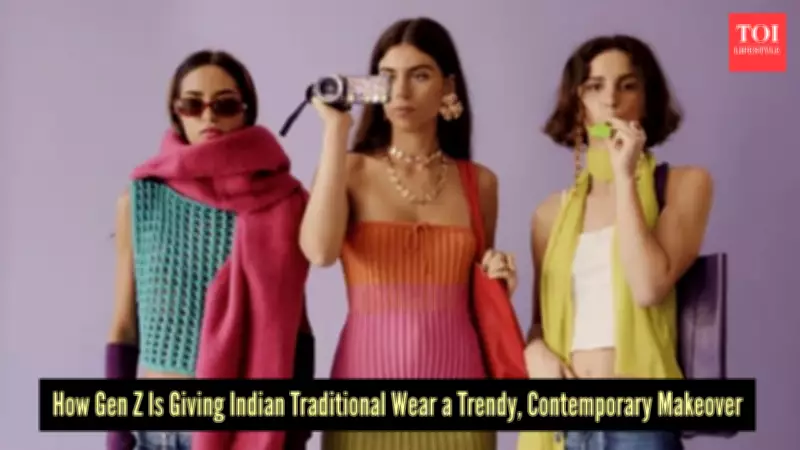
Halter neck kurtas styled with ripped jeans, corset tops in Jaipuri prints paired with sneakers, block print co-ords adorned with chunky jewellery and Kolhapuris—these are the quiet markers of a retail revolution led by young India that is reshaping the face of Indian wear. While Indian wear has long been an integral part of the everyday wardrobe, it is now undergoing a significant shift with evolving cuts and silhouettes that are central to Gen Z's idea of self-expression.
The Consumer Has Changed. The Industry Is Catching Up.
Indian Gen Z is unlike any consumer cohort the fashion industry has encountered. They are digitally native, culturally assured, and value-conscious rather than simply price-sensitive. Unbound by a need for validation for their aesthetic choices or by age-old traditions dictating how Indian wear should look, they are crafting a design language of their own. For this young India, clothes are no longer about meeting social expectations—they are the most personal form of self-expression, a creative outlet that declares to the world who they are at first glance. This shift from conformity to individuality is at the root of almost every behavioural change the retail space is witnessing today.
The Collapse of the Occasion-Wear Framework
The most visible expression of this change is the collapse of the occasion-wear framework. For decades, Indian wear operated on a predictable consumption rhythm built around weddings, festivals, and family functions. Gen Z has actively dismantled this by merging the most distinct aspects of Indian and western wear, resulting in an inspired fusion style that now permeates college, formal, and casual wear. Clothes are no longer a response to an occasion but a statement made on their own terms.

Three Forces Driving This Change
Three distinct forces drive this behavioural shift. The first is cultural confidence, derived from a sense of pride that stems from strong Indian cultural assertion across music, food, film, and lifestyle in recent years. Wearing ethnic is no longer a concession to tradition but a proud, deliberate style choice. The second is social media as a style education platform. With access to global fashion references since their early teens, Gen Z is more silhouette-aware, styling-literate, and demanding as consumers than any previous cohort. They are not passive recipients of content; they are creators setting the terms. The third is the seamless integration of the Indian and western wardrobe. For older consumers, these were separate wardrobes for separate contexts. For Gen Z, there is only one wardrobe, and it reflects the full complexity of who they are. This convergence is visible not only in Indian brands but also in how global brands are reimagining their design language.
The Silhouette Is Now the Signature
For most of Indian wear's commercial history, the cut was secondary to fabric, print, and embellishment. Today, for young consumers, the silhouette is a major deciding factor of whether an outfit feels conformist or liberating. A Jaipuri print on a conventional silhouette reads as traditional. The same print on a halter neck, a corset top, or a kurta with flared sleeves reads as a choice—and that distinction is key. Gen Z is seeking body-contouring, fusion-forward, and versatile fits that can be styled fluidly and worn across occasions without sacrificing authenticity. Brands that respond to this disruption with reimagined styles will prevail. Those relying solely on conventional silhouettes will find it increasingly difficult to engage with this audience, regardless of product quality or heritage.

The Value Equation Has Been Permanently Reset
The younger generation’s purchase behaviour is markedly different from other consumer cohorts. With significantly higher market awareness, their guiding principle is not price but value for money. They can distinguish between a premium that reflects craft and quality and one that reflects legacy positioning. This generation will not pay for a brand name unless the aesthetic aligns with their values and evokes a personal connection. In a market where digital-first brands have demonstrated that design-forward Indian wear can be delivered at accessible price points, the value expectation has been permanently recalibrated. The brands winning in this space treat price as a design decision made at the beginning of the process, not a margin decision made at the end. This shift separates brands genuinely building for this consumer from those simply reacting to them.
What the Industry Must Confront
Indian wear is undergoing a categorical transformation, and Gen Z is at the helm of this change. They are not just new customers; they are a new contract, and the industry would do well to read it carefully. At this inflection point, surviving these transformations will require questioning foundational assumptions about Indian wear—that it is for occasions, that heritage justifies premium pricing, that the product speaks for itself. This generation is not looking for a brand that shapes their wardrobe; it is looking for brands that fit into their language. Trust is currency with Gen Z, and brands that earn it through how they design, price, and engage with culture and community will define the next chapter of Indian fashion.
Inputs by: Siddharth Bindra, Managing Director, BIBA