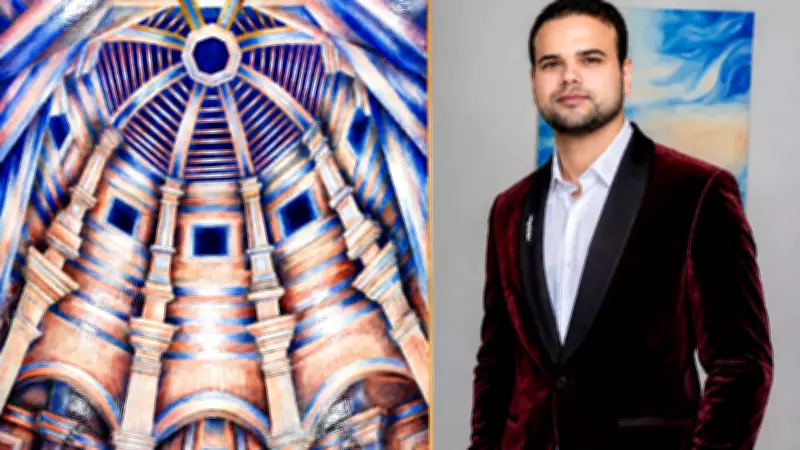
Painting, in its most reductive definition, is an act of addition. An artist comes to the canvas with pigment, with intention, with the accumulated grammar of training, and builds. Giovanni Guida does not follow this path. He arrives at the canvas and begins, methodically, to take it apart.
The Technique of Grattage
His medium is grattage, a technique with Surrealist origins, tied to psychic automatism and the excavation of the unconscious. However, Guida has performed a quietly audacious transformation. He has turned an apophatic gesture into a devotional one. The visual language he employs is precise and deliberately ancient. Lapis lazuli, that impossible blue of Byzantine domes and Marian iconography, runs through his practice like a leitmotif. It is a color carrying centuries of sacred meaning, and in Guida's hands, it feels not borrowed but inhabited.
From Freudian Unconscious to the Divine
In a conversation, Guida speaks with the precision of a theologian and the instinct of a painter. When asked about Max Ernst, who invented grattage to reach the Freudian unconscious, Guida explains: "It is neither a clean break nor a simple continuation; rather, it is an elevation—a vertical evolution." He elaborates that Ernst used grattage to excavate the horizontal layers of the Freudian unconscious, uncovering untamed, subterranean forces of the psyche. Guida's approach does not oppose this; it shifts the axis from the psychological to the ontological. "If Ernst looked into the abyss of the ego, I look through the canvas to find what the Vedic tradition calls Atman and what Western mysticism calls the Divine." By scratching away the pigment, he is not trying to expose hidden trauma but to tear the veil of Maya to reveal the unconditioned Light beneath. On this centenary, his grattage honors Ernst's method but changes the destination: "we are no longer digging into the dark basement of the mind, but opening a window toward the Absolute." It is surrealism returning to its truest, most sacred origin: the search for a higher reality.

When Grattage Became His Own
Every artist has a moment when a technique stops being something learned and starts being something they are. Guida recalls: "It happened when I stopped treating the canvas as a surface to be decorated and began treating it as a threshold to be crossed." Initially, grattage was a mechanical act of subtraction. But a specific moment in his studio transformed his tool from an external instrument into an extension of his being. "I realized I wasn't 'painting' anymore; I was performing an act of spiritual archeology." The exact turning point was when he stopped predicting the result. In traditional painting, one adds brushstrokes to build an intended image. In his grattage, the final image is born from a dialogue with the unknown. "When I understood that my role was not to impose a form, but to liberate a light that was already trapped under the dark layers of paint, grattage ceased to be a technique. It became my way of breathing, my way of seeing the world through the act of uncovering."
The Moment of Revelation
Most artists build a surface. Guida grattages. When asked what it feels like when the canvas gives way and something unexpected emerges, he describes: "Most artistic traditions are Demiurgic—they add matter to a void, building a universe layer by layer. My process is apophatic, much like the theological concept of Via Negativa (knowing God by stating what He is not), or the Upanishadic Neti Neti ('not this, not this')." The moment the canvas gives way under his tools is a moment of profound vulnerability and suspense. It feels like an epiphany. There is a sacred tension because one reality is being destroyed to allow another to be born. Through grattage, the tool penetrates the pigment to reveal what lies beneath, yet allows it to be scrutinized by gazing at it within its very act of hiding. "When that unexpected streak of light or texture breaks through, it feels as if the canvas itself is speaking. It is the exact visual translation of Anatta (non-self): the ego of the artist steps aside, the conscious mind surrenders, and the painting reveals its own true, unconditioned nature."

Art in Sacred Spaces
Guida's work Caesarius Diaconus has been placed beside actual relics of a saint in cathedrals across the world. The realization that he was no longer just making art but creating something people prayed near came when he witnessed the shift in how the work was approached. "In a museum, people look at a painting; in a cathedral, next to the relics of St. Caesarius, people look through it. It ceases to be an aesthetic object and becomes an acheiropoieton—an image not made by human hands, a liturgical mirror." Iconologically, an artwork placed next to a relic changes its ontological status: it absorbs the sacred aura of the space and the collective devotion of the faithful. When he saw candlelight reflecting on the scratched surfaces of Caesarius Diaconus and people bowing their heads near it, he felt a deep sense of responsibility. "I realized that my art had become a bridge between the visible and the invisible. It was no longer about my signature or my skill, but about creating a space where silence and prayer could find a visual echo."
The Significance of Lapis Lazuli
Lapis lazuli blue runs through almost everything Guida makes. He reflects on whether he chose the color or it chose him: "In the Western iconographic tradition, Lapis Lazuli is the color of the transcendent—the cloak of the Virgin Mary, the sky of Giotto, the hue of the unapproachable heavens. In the East, it is the color of the higher chakras, the infinite depth of consciousness." He believes that lapis lazuli chose him because it demands a process of spiritual stripping, where the artist becomes immaterial, dissolving his own ego to 'un-veil' himself. Through grattage, scratching away the dark layers of pigment is an ascent to reach 'the blue of the gentle blueness of the sky, the true color of depth in which the Absolute manifests itself without veils.' This is not a superficial, blinding illumination. As philosopher Martin Heidegger noted, this celestial depth is not a vain light: 'the splendor of its height is in itself the darkness of its all-embracing breadth.' Therefore, lapis lazuli chose Guida as an ontological reminder: it is a color that holds both the abyssal shadow and the cosmic dawn. Its true luminosity is only awakened when liberated from the surface, showing that no matter how much darkness we lay upon the world, the underlying fabric of reality is an infinite, divine embrace.
What is remarkable is the reception Guida's work has found outside gallery walls entirely. Placed beside relics in active cathedrals, his paintings have entered the liturgical space, not as art objects to be admired, but as presences to be reckoned with.
About the Author
Maitree Baral is a health journalist on a mission: making medical science digestible and healthcare approachable. Covering everything from wellness trends to life-changing medical research, she turns complex health topics into engaging, actionable stories readers can actually use.