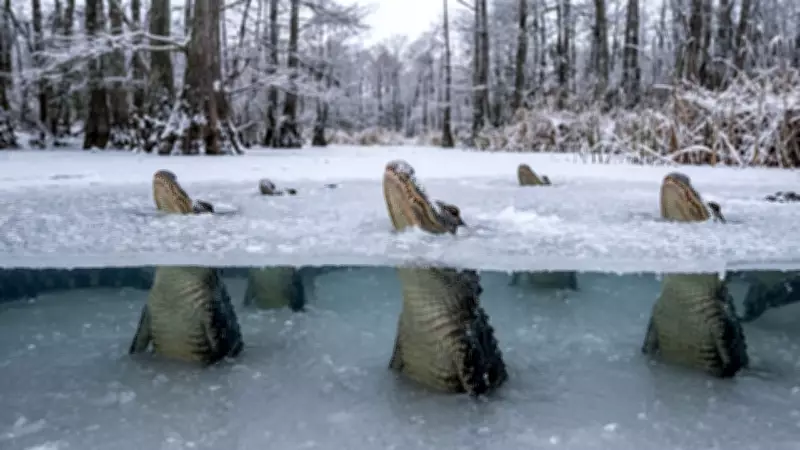
During winter, when temperatures drop dramatically in certain areas of the southern United States, an intriguing wildlife phenomenon occurs. Alligators become trapped in frozen ponds with only their heads exposed, a unique adaptation that allows them to survive frigid temperatures. This behavior, known as “icing behavior,” enables the reptiles to remain under frozen pond waters without suffering the effects of low temperatures due to a slowed metabolic rate, while still breathing through their nostrils. This fascinating observation has been documented in places like North Carolina and Texas. Biologists believe that the physiology and behavior of alligators allow them to endure such harsh winter conditions.
What Happens When Alligators Freeze Themselves in Ice
At first glance, this might seem shocking. A whole pond can freeze, trapping several alligators under the ice with only their nostrils poking above the water level. However, the animals are typically alive and simply conserving energy. According to North Carolina State University, alligators are ectothermic reptiles whose body temperature depends on environmental conditions. When the weather becomes too cold, their metabolic rate significantly decreases, requiring less energy to survive. Employees from Shallotte River Swamp Park in North Carolina observed this behavior in cold weather and explained that alligators always ensure their heads are above the water level before freezing occurs, allowing them to breathe despite being trapped by ice. Once temperatures rise, the reptiles become more active again.
The Science Behind Alligator’s Winter Survival
In scientific circles, the icing phenomenon is recognized as a critical evolutionary trait that has developed over millennia. Alligators originate from tropical regions, but some populations in northern areas of their habitat face severe winters. Professor Emeritus Paul Smithson from Berea College indicates that alligators undergo brumation in winter. Unlike mammalian hibernation, this process does not involve a state of sleep but is characterized by minimal activity. This means that all physiological processes, including heartbeats and metabolism, slow down. Since reptiles are inefficient heat generators, conserving energy is vital for their survival. According to physiologists specializing in reptile anatomy, even icing may not always protect alligators from the effects of prolonged freezing, as they could sustain injuries leading to death. The icing strategy only helps them survive short-term freezing when their snout remains above the ice layer. Wildlife experts have established that juvenile alligators are more susceptible to freezing conditions than adults because they lose heat faster.

Where This Behavior Is Commonly Seen
Icing behavior occurs more commonly in wetlands and swamps in the southeastern United States. States like North Carolina, South Carolina, Georgia, and Texas have experienced cold outbreaks with temperatures low enough to freeze small water bodies. This phenomenon can be observed at places like Ocean Isle Beach. The Swamp Park has also uploaded videos featuring alligators surviving beneath a layer of ice covering small ponds. This behavior tends to fascinate foreign audiences, as reptiles generally thrive in hot tropical environments. However, everyone should note that although the reptiles appear peaceful and motionless, they must not be disturbed, as the shock can adversely impact their survival rate.
Why Alligator Icing Fascinates Scientists
The phenomenon of alligators surviving partial freezing continues to intrigue zoologists and climatologists. They suggest that understanding the mechanism of cold resistance in reptiles could contribute to studies in evolutionary biology, metabolic adaptation, and survival in changing climate conditions. The American alligator can be considered a “living fossil,” having survived significant climatic changes over millions of years. Observing how alligators respond to environmental challenges provides insights into their resilience. With an increase in abnormal weather phenomena, instincts like icing become particularly crucial for animal survival. A frozen alligator may seem strange, but it is undoubtedly fascinating to people.