Indonesia Joins BrahMos Club
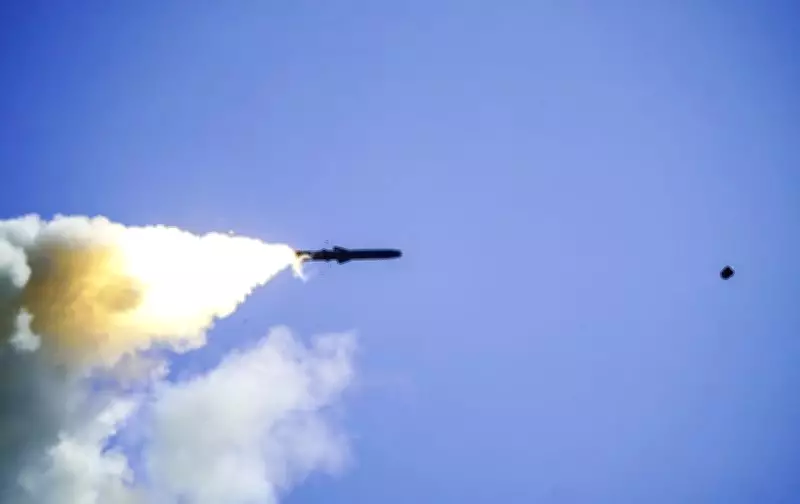
India's decision to cooperate with Indonesia on providing the BrahMos supersonic cruise missile signals a strategic shift beyond simple arms sales. On July 7, Prime Minister Narendra Modi met Indonesian President Prabowo Subianto, and a joint statement announced cooperation on BrahMos, making Indonesia the third country after the Philippines and Vietnam to acquire the missile. This move potentially alters the military balance in a region China considers its backyard.
The BrahMos, produced under an India-Russia joint venture, will not provide these three countries parity against Chinese missile might but sets a benchmark of deterrence against unilateral military pressure. Indonesia sits astride four major straits—Malacca, Lombok, Sunda, and Ombai-Wetar—connecting the Indian Ocean with the Pacific Ocean. All four are major shipping arteries, and Jakarta, like the other two Southeast Asian nations, has sought mobile coast-based batteries with abilities to hit targets 290 km at sea.
MTCR Constraints and Operational Fit
The Missile Technology Control Regime (MTCR) imposes restrictions on range, capping the BrahMos at 290 km. A battery includes launchers, radars, and missiles. The flexibility of the BrahMos allows its deployment across land, air, and sea. Deals with the three Southeast Asian nations position the missile as a real-fit for operational needs in the region.

Vice Admiral Sanjay J Singh (retd), former Western Navy Commander during Operation Sindoor in May last year, says: 'BrahMos is in high demand as it has proved itself in the conflict zone with its high accuracy and effectiveness. It is a testimony to indigenous defence technological capability, and the value of joint ventures with reliable partners.'
Strategic Deterrence Without Interception
Maj Gen SK Shrivastava (retd), former Chief Instructor at the Army's School of Artillery, says the missile cannot be intercepted mid-air, making it popular worldwide. 'This single data point alters the global strategic calculus,' he adds. 'The missile's survivability is due to technology like supersonic velocity, low-altitude skimming, terminal manoeuvrability, precision and lethality. However, its true value lies in strategic deterrence—a non-contact, kinetic deep-strike capability.'
India's Shift in Defence Diplomacy
The export of the lethal, supersonic, fire-and-forget BrahMos to ASEAN nations—especially those with overlapping maritime claims in the South China Sea—highlights a shift. New Delhi is actively sharing advanced technology with regional partners to secure maritime commons outside of traditional blocs. The Philippines was the first mover, signing a $375 million contract in 2022, with deliveries starting in 2024. At the Shangri-La Dialogue in Singapore in May this year, Defence Secretary Rajesh Kumar Singh said India and Vietnam have signed a deal for the BrahMos, reportedly valued at approximately $620 million.
Future Markets and Constraints
The UAE is a possible future buyer in West Asia, taking BrahMos beyond the Indo-Pacific market. Other interested countries include South Africa, Brazil, Chile, Malaysia, Saudi Arabia, Qatar, Oman, and Egypt. Some of these nations explore options to avoid complete dependence on the US, China, or Europe. India offers a relatively simple strategic and credible deterrence without the burden of alliance alignment. However, the export story also means India must manage end-use monitoring, technology transfer limits, and political consequences of missile proliferation. Since BrahMos is a joint programme with Russia, its export expansion is a shared framework requiring strategic and diplomatic management.
Three Paths of Progress
There are three clear paths for future progress: miniaturise the missile for deployment on various fighter jets; extend the range to strike targets beyond 1,500 km; and standardise it on all Naval warships. A smaller version of the conventional BrahMos is already integrated onto Sukhoi-30MKI jets of the Indian Air Force (IAF) and was used during Operation Sindoor. The newer miniature version, BrahMos-NG, would be lighter at about 1.5 tonnes, enabling smaller jets like the Tejas to carry it.

Last month, speaking at an event in Nagpur, Chief Executive Officer and Managing Director of BrahMos Aerospace Jaiteerth Joshi said: 'We are going with the BrahMos-NG and we are also going for additional distances, very large distances.' On Naval growth, Admiral Singh, now Director-General of think tank United Service Institution of India (USI), argues: 'BrahMos as the primary weapon for long-range strike is commensurate with the Indian Navy's increased role, reach and readiness.'
Longer Range Versions
The BrahMos long-range version will be a gradual development. The IAF has tested an air-launched variant beyond 450-500 km, achieved through upgraded ramjet propulsion management and optimised fuel efficiency. The Army wants a range of 800-plus km, allowing stand-off precision strikes deep into adversary territory from safely inside domestic borders. Maj Gen Shrivastava says: 'The upcoming hypersonic, longer-range version will only multiply this dominance.' First test-fired 25 years ago in June 2001, the BrahMos has come a long way and is now the weapon of choice.