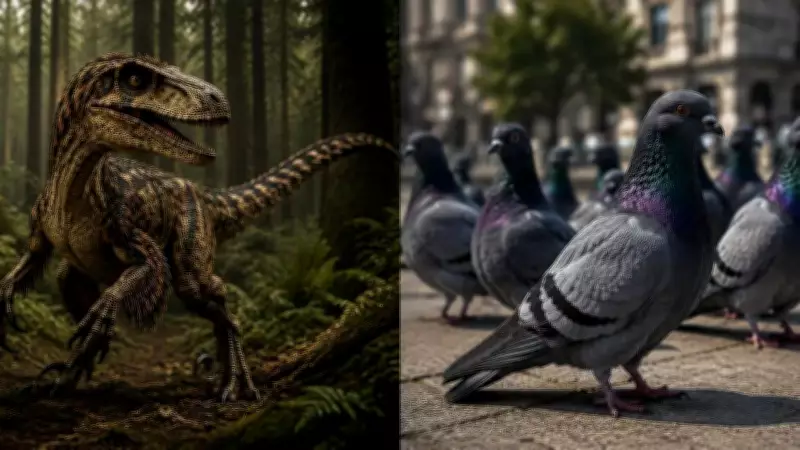
A pigeon pecking at crumbs in a city square rarely attracts much attention. It is easy to see it as an ordinary bird, part of the background of daily life. Yet its ancestry reaches back into a world that looked nothing like our own. Long before parks, roads and buildings existed, Earth was home to a remarkable variety of dinosaurs, including swift hunters that dominated ancient landscapes. According to the Natural History Museum in London, modern birds are not simply related to dinosaurs in a distant sense. They are the surviving branch of a much older dinosaur lineage. That understanding has steadily changed the way palaeontologists interpret prehistoric life and has reshaped public perceptions of dinosaurs themselves.
How dinosaurs evolved into birds through new fossil discoveries
The popular image of dinosaurs has undergone a dramatic transformation over the last two centuries. Early scientists often pictured them as enormous reptilian creatures that spent much of their time moving slowly through ancient environments. Their appearance was imagined as heavily scaled, and little attention was given to the possibility of complex behaviour.
As per the Natural History Museum, this perspective began to shift during the twentieth century as new fossil discoveries accumulated. Researchers started finding evidence that suggested many dinosaurs were far more active than previously believed. Their anatomy hinted at agility, speed and behaviours that seemed surprisingly familiar. This period of reassessment became known among palaeontologists as the dinosaur renaissance, a time when long-standing assumptions were challenged by fresh evidence.

The result was a completely different picture of dinosaur life. Instead of seeing them solely as giant reptiles, scientists increasingly viewed them as dynamic animals whose evolutionary story was far more complex than once imagined.
Deinonychus and the link between dinosaurs and birds
A significant turning point came with the discovery of Deinonychus, a predatory dinosaur that lived roughly 115 million years ago. According to the Natural History Museum, its skeleton displayed features that closely resembled those seen in birds. It also appeared capable of rapid movement, helping to undermine the traditional image of dinosaurs as sluggish creatures.
The importance of Deinonychus extended beyond its physical structure. It encouraged scientists to reconsider the relationship between birds and dinosaurs altogether. Rather than treating birds as distant relatives, researchers increasingly began to view them as direct descendants of a particular dinosaur group known as theropods.
This shift gained momentum as additional fossils were uncovered and older specimens were re-examined. Similarities between birds and certain dinosaurs became increasingly difficult to ignore. Features once considered unique to birds appeared to have deeper evolutionary origins stretching back millions of years.
The role of feathers in how dinosaurs evolved into birds
One of the most influential discoveries involved feathers. For decades, dinosaurs had been portrayed with reptilian skin, but fossil evidence eventually revealed that feathers were present among several dinosaur species long before the appearance of modern birds.
As per the Natural History Museum, Deinonychus itself is now believed to have possessed feathers, despite earlier reconstructions depicting it as entirely scaly. This discovery forced scientists to rethink not only how dinosaurs looked but also how they lived and evolved.
At the same time, some theropod groups underwent a gradual reduction in body size. Across many generations, these dinosaurs became smaller and developed skeletal features that increasingly resembled those of birds. Scientists believe that some species may have spent more time in trees, seeking food or safety, creating conditions that favoured further evolutionary adaptations.
The emergence of birds was not a sudden event. Instead, it unfolded through a long sequence of incremental changes that took place over millions of years. Characteristics associated with flight and bird anatomy accumulated gradually, blurring the distinction between dinosaurs and the earliest birds.

Why are birds the only surviving dinosaurs?
The evolutionary connection between birds and dinosaurs is now supported by a substantial body of fossil evidence. According to the Natural History Museum, birds emerged from within the theropod dinosaur lineage rather than alongside it. This means birds are not merely descendants of dinosaurs in a general sense; scientifically, they represent the only surviving branch of that ancient group.
The fossil Archaeopteryx is often described as one of the earliest birds, yet researchers now understand that many bird-like features had already evolved among dinosaurs before its appearance. This has reinforced the idea that the transition from dinosaur to bird occurred gradually rather than through a single evolutionary leap.
Discoveries continue to refine scientific understanding of this process. Fossils regularly reveal details that challenge earlier assumptions about dinosaur appearance, behaviour and ecology. What remains clear, however, is that the story of dinosaurs did not end with extinction.
Every sparrow, pigeon and crow carries traces of an ancestry that stretches back to the age of dinosaurs. The skies above modern cities are filled with living reminders of a lineage that survived when all other dinosaur groups disappeared, preserving a direct link to a prehistoric world that still echoes through the birds around us today.