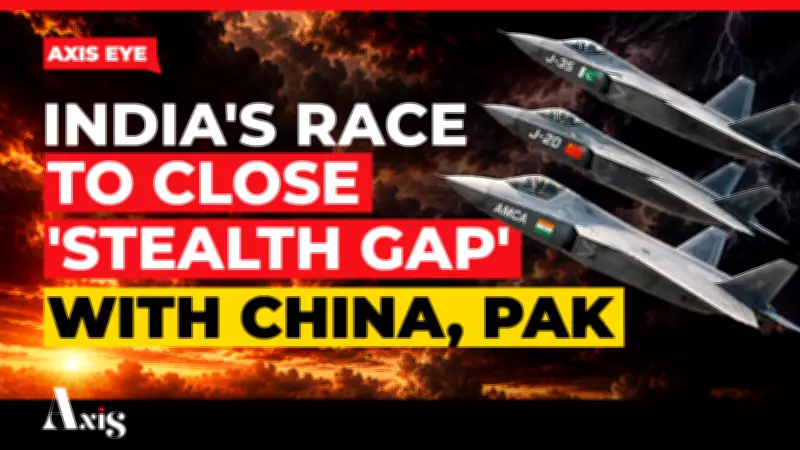
India's stealth fighter program has entered a critical phase as New Delhi accelerates efforts to close a widening air power gap with China and Pakistan. For the first time, private sector companies are being invited to participate in the Advanced Medium Combat Aircraft (AMCA) project, breaking the long-standing monopoly of state-owned Hindustan Aeronautics Limited (HAL).
Why the AMCA Matters
The AMCA is India's indigenously developed fifth-generation stealth fighter, designed to rival aircraft like the Chinese J-20 and J-35. China is expected to field nearly 1,000 J-20 stealth fighters by 2030, while Pakistan is rapidly advancing its acquisition of Chinese J-35 aircraft. India currently has no operational fifth-generation fighter, leaving a significant capability gap in the region.
Breaking HAL's Monopoly
The decision to involve private players marks a strategic shift in India's defense manufacturing. By opening the AMCA project to private industry, the government aims to leverage innovation, reduce costs, and accelerate development timelines. This move is expected to bring in expertise from companies like Tata, Mahindra, and Larsen & Toubro, which have previously contributed to other defense programs.

Strategic Risks of Delay
Delays in the AMCA program could have dangerous consequences. China has already deployed J-20 fighters near the Sikkim border, and Pakistan's deepening partnership with China's air force is strengthening its stealth capabilities. The stealth race in Asia is no longer theoretical; it is already underway. India's inability to field a fifth-generation fighter in time could undermine its strategic deterrence and air superiority.
What's Next for AMCA?
The AMCA is expected to make its first flight by 2028, with initial operational capability by 2030. The project will involve extensive collaboration between DRDO, HAL, and private partners. Key features include advanced stealth design, supercruise capability, and network-centric warfare systems. India is also exploring a twin-engine variant for naval operations.
The government has allocated significant funding for the AMCA, with an estimated development cost of over $2 billion. Production is planned in phases, with a target of 120 aircraft for the Indian Air Force and 60 for the Navy.
Regional Implications
The AMCA program is part of India's broader strategy to modernize its air force amid rising threats from China and Pakistan. Alongside the Rafale deal and indigenous Tejas program, the AMCA will form the backbone of India's future combat fleet. Success will not only close the stealth gap but also boost India's defense industrial base and self-reliance.
As the stealth race intensifies, India's ability to deliver the AMCA on time will be a key determinant of its strategic autonomy and regional influence.