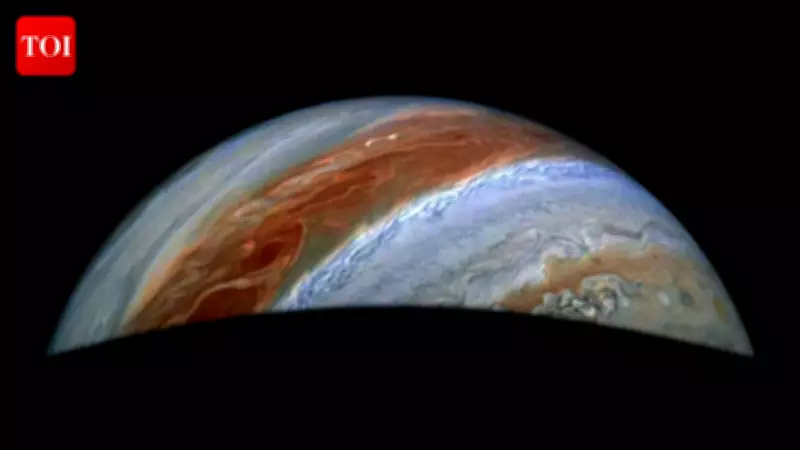
When you think about what makes life on Earth possible, you probably picture sunshine, water, a cozy atmosphere, and the perfect spot in our solar system. Your thoughts rarely go towards Jupiter, other than being aware that the giant planet is one of the eight planets we share space with. Jupiter is usually just a distant gas giant: massive, beautiful, but basically background scenery. But lately, researchers are flipping that idea upside down.
Now, a NASA-supported study says Jupiter may have been absolutely critical in bringing life's building blocks to our planet. Without Jupiter, the story goes, Earth might have missed out on the ingredients needed for life altogether.
Jupiter Helped Earth to 'Create' Life?
At first, it sounds wild. Jupiter is a swirling mass of gas with crazy storms, which is not exactly fertile ground. But, as per Phys.org, scientists now believe its powerful gravity sculpted the early Solar System, deciding whether planets like Earth became barren rocks or places that could host living things.

The question in focus: Where did Earth's 'ingredients for life' actually come from? Every living cell needs what scientists call CHNOPS, which is the acronym for carbon, hydrogen, nitrogen, oxygen, phosphorus, and sulfur. Some were common when the Solar System formed. Others had to travel in from farther out. Untangling how these elements got to Earth has always been a big question.
Researchers tackled this using ancient meteorites, which are like frozen snapshots from the Solar System's early years. By analyzing their chemical makeup, they could see how life-supporting elements got shuffled around. Turns out, Jupiter played a huge role in this cosmic sorting.
Jupiter: A Cosmic Traffic Cop for Gravity
Jupiter didn't just sit there looking pretty; rather, it acted like a giant traffic cop for gravity. It formed early, grew fast, and its mass started tugging everything nearby. The team believes Jupiter redirected dust, rocks, and chemical-rich material toward the inner Solar System, where Earth was forming. Some vital compounds, like phosphorus and nitrogen, arrived here probably because Jupiter tossed them inward billions of years ago.
So, life's ingredients didn't just stumble their way to Earth — they needed a push. 'This changes how we think about planetary habitability,' scientists said. In other words, it's not just about having the right planet in the right spot, but also about whether neighboring giants help or hinder the ingredients for life.
Jupiter's Reputation as Earth's Guardian Just Keeps Growing
For years, astronomers thought Jupiter shielded our planet by intercepting or redirecting space rocks that could threaten us. Its huge gravity acts as a cosmic bodyguard, lowering (or sometimes increasing) the risk of impacts. There is debate about how well this works, but one thing is clear: Jupiter shapes the Solar System in tons of ways.
Beyond impacts, Jupiter helped organize the planets, formed the asteroid belt, and even has long-term effects on Earth's orbit and climate cycles stretching over millions of years.
Implications for Exoplanet Habitability
This new understanding is changing how astronomers look for life out there in the galaxy, too. With thousands of exoplanets discovered, scientists usually search for rocky worlds in habitable zones. Now, the advice is to check who their neighbors are. No nearby Jupiter-like giants? That exoplanet may never get the stuff needed for life.
Now, Jupiter wasn't the only player. Research suggests that life's origin is still one of the wildest puzzles out there, with countless factors like water, plate tectonics, the Sun, climate, and more. But the latest NASA-backed research hints at something extraordinary: one of the most important pieces in Earth's life story might be a planet millions of miles away.
For ages, we have watched Jupiter as the distant neighbor in the same solar system. Now, scientists think it might have been an incredibly crucial one — it is that neighbor who maybe, just maybe, helped deliver the raw materials for life, forests, and eventually us. If the new science is right, Earth's origin is not just Earth's tale; it is Jupiter's, too. The big planet did not just stand by; it shaped the cosmic stage for life long before our planet even started forming.