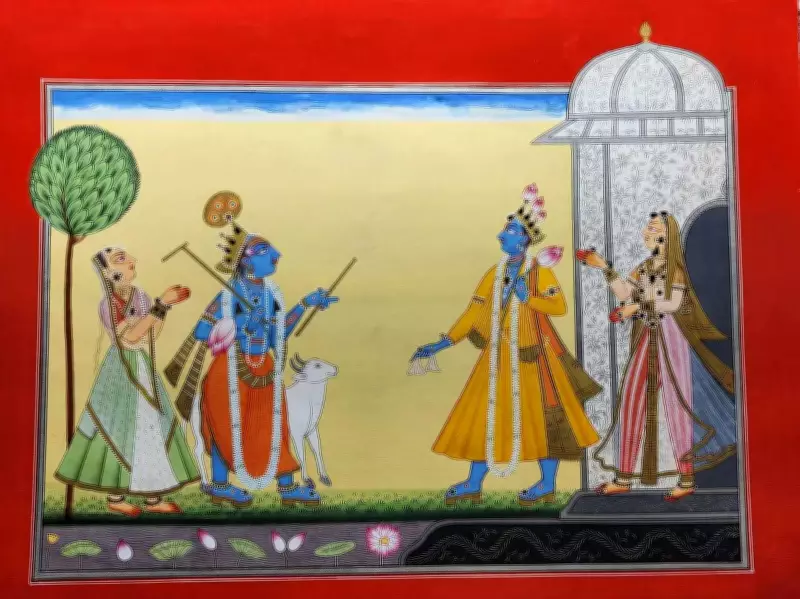
The gopis' rati bhav, a sensually evocative and ecstatic love for Krishna, is expressed through numerous lilas and kridas of Krishna in the mythic Vrindavan of the Dasham Skand of the Bhagavat Puran. The Dasham Skand transforms rati bhav into shringar rasa, where Krishna's madhurya and viraha, two opposite ardh satyas, blend into a seamless purna satya. As a result, the sakar becomes nirakar, the particular becomes universal, the temporal becomes timeless, the laukik becomes alaukik, and there is a state of vismaya, wonder.
The Eternal Dance of Purush and Prakriti
In the Bhagavat, the single and steadfast Purush, through His lilas, becomes the manifold, polychromatic Prakriti, and Prakriti, through shringar, returns to Purush. This is the eternal dance of Purush and Prakriti. This is a state of advaita, reached through a two-step process: Kama is replaced by Krishna, kamana by jnan; for gopis, Krishna is sensually evocative, and even though absent, is present everywhere. This is Shuddh Advaita, where sensuality, set in an idyllic landscape, becomes the doorway to knowledge.
Krishna Shringar as Brahmnjan
Krishna shringar in the Bhagavat is Brahmnjan; it is not a romantic story but a pathway to higher knowledge. Krishna shringar in the Bhagavat avoids the didactic teaching found in the Gita and leads us from joy to greater joy and from sensuality to spirituality. The teaching of the Bhagavat is as if your beloved is whispering sweet words into your ear or holding your hand and walking you through an aromatic garden.

Contrast with the Gita
In the Gita, Arjuna is in a state of vishad, is undecided and confused on the battlefield of Kurukshetra, and turns to Krishna for guidance. Gopis, on the other hand, are joyous and want to participate in lilas and kridas of Krishna in Vrindavan so that they can go from joy to greater joy, from ardh satya to purna satya, from kamana to jnan. Aesthetics or the realisation of satya through engaging with what is satya and sundaram is a late starter in the Indic wisdom tradition.
Historical Context of Indic Aesthetics
The Bhagavat was composed between the 8th and 10th centuries. Before that, Indic thought was largely dominated by Advaita Vedanta, Buddhist philosophical precepts, and ascetic Jain monks' teachings which promoted abstinence, renunciation, and freedom from sensual attachment. Aesthetics, in the Indic tradition, faced an uphill task in becoming a self-standing knowledge system. This was due to several reasons. First, beauty for the Indian mind was intimately tied to divinity. In other words, for mankind, only the Divine can be truly beautiful. Tukaram, when referring to Vitthal of Pandharpur in his abhang, says, “sundara te dhyan, vite var...” For him, as for most Indians, true beauty can only reside in our gods and goddesses, in their icons and rites and rituals. Secular beauty can at best be secondary to this. Secondly, the hyper-erotic culture around tantra took the concept of beauty into realms of eroticism.
Pioneers of Aesthetic Thought
Rishis such as Bharata with the Natyashastra, Anandavardhana with the Dhvanyalokah, and Abhinavagupta with Abhinavabharati had prepared the way for aesthetics, or knowledge through saundarya. Krishna bhakti reinterpreted sensuality of shringar, suggesting that without any religious rites or rituals, it could lead to transcendent knowledge, Brahmnjan.
Transformation of 'Madhu' into 'Madhurya'
Krishna bhakti framework transformed the word ‘madhu’ from the Rig Veda into ‘madhurya’, an adjective that becomes a contemplative noun. This was a significant development in the field of aesthetics. While shringar was already an established aesthetic category in India, the portrayal of Krishna’s divine love in the Bhagavat Puran gave it one of its most influential and enduring expressions. Krishna shringar of the Bhagavat is a crowning achievement of Indic aesthetic thought.
Authored by: Harsha V Dehejia