

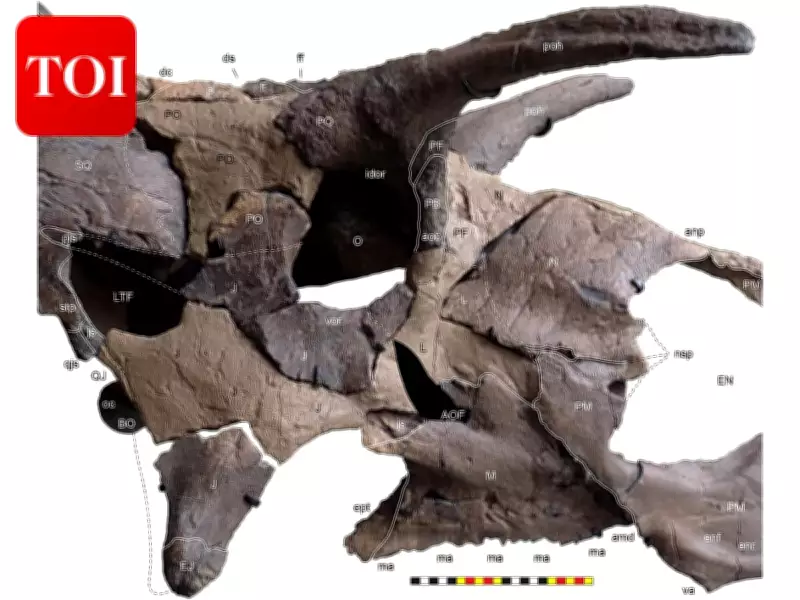
If you thought Triceratops had impressive headgear, wait until you learn about its older, more unusual relative. In 2024, scientists unearthed a new dinosaur species in the badlands of northern Montana, near the Canadian border. They named it Lokiceratops rangiformis. Its skull displayed a combination of features rarely seen together.
Distinctive Features of Lokiceratops
Lokiceratops is one of the largest and most ornate horned dinosaurs of its time, boasting two large, blade-like horns on the back of its frill. However, its most peculiar trait is asymmetry. The irregular frill ornamentation on each side inspired its species name. Lokiceratops means "Loki's horned face," after the shape-shifting Norse god, while rangiformis refers to the irregular antlers of caribou and reindeer. Notably, it lacked a nose horn—not due to damage, but naturally absent.
Size and Age
This was no small creature. Lokiceratops measured approximately 22 feet in length and weighed over 11,000 pounds, comparable to an African bush elephant. It lived 78 million years ago, about 12 million years before its famous cousin, Triceratops. The fossils were first discovered in 2019, but reconstructing the skull from dozens of fragments took years. The frill horns are the largest ever found on any dinosaur.

Scientific Significance
The bizarre combination of features—the missing nasal horn and enormous asymmetrical frill horns—was not an anomaly of a single animal, according to the peer-reviewed study published in PeerJ. This warranted the creation of a new genus and species, a significant event in paleontology.
Broader Implications: Dinosaur Provincialism
Lokiceratops lived on an ancient landmass called Laramidia. During the Late Cretaceous, a shallow sea split North America, making western Laramidia an island continent from Mexico to Alaska. Scientists suspected dinosaurs there evolved in isolated regional populations, with different species in the north and south. The PeerJ study confirms this pattern with striking detail.
The authors found that five different ceratopsid species, including Lokiceratops, coexisted in the same small area of northern Laramidia at roughly the same time. This high diversity in a limited geography suggests rapid local evolution rather than wide-ranging, slow-changing populations. This idea was supported by a landmark PLOS ONE study by Sampson et al., which documented distinct chasmosaurine taxa in northern and southern Laramidia, providing evidence of intracontinental endemism among dinosaurs.
Lokiceratops adds to the evidence that the American West was not a single dinosaur habitat but a patchwork of local ecosystems, each producing unique species.
Importance Beyond Fossils
For paleontologists, this discovery is quietly thrilling. The American West is one of the most studied fossil regions, yet in 2024, a new genus of giant horned dinosaur emerged in Montana, hidden in rock for 78 million years. The study suggests that dinosaur diversity in this region may have been underestimated, hinting at more discoveries to come. Montana, Wyoming, and Utah badlands still hold surprises. Lokiceratops reminds us that North America's prehistoric past is not fully written, and future fieldwork may reveal even more.






