Moon's 1.5-Billion-Year Ice Accumulation Revealed in New Study
Scientists have long focused on the Moon's polar regions, particularly the Permanently Shadowed Regions (PSRs), due to the presence of water ice. A groundbreaking study published in Nature Astronomy now confirms that the Moon has been accumulating this ice for approximately 1.5 billion years. This discovery sheds light on the gradual processes that have shaped lunar resources over eons.
Steady-State Ice Build-Up from Comets and Solar Wind
Researchers utilized data from NASA's Lunar Reconnaissance Orbiter (LRO) to analyze the ice accumulation. Their findings indicate that the build-up is a steady-state process, with water delivered primarily by comets and solar wind. As the Moon's axial tilt has shifted over time, these frigid traps have expanded, capturing more water than when they initially formed.
The study highlights that the polar regions of the Moon can provide a valuable resource for future missions, enabling more efficient exploration of deep space by offering in-situ materials.

Correlation Between Cold Trap Age and Ice Content
A key insight from this research is the correlation between the age of a cold trap and its water ice content. The Lyman-Alpha Mapping Project (LAMP) study suggests that the Moon has experienced a decreasing angle of axial tilt, or obliquity, since the formation of its PSRs. This orbital change has caused various lunar polar craters to fall within permanent shadow at different points in the Moon's history.
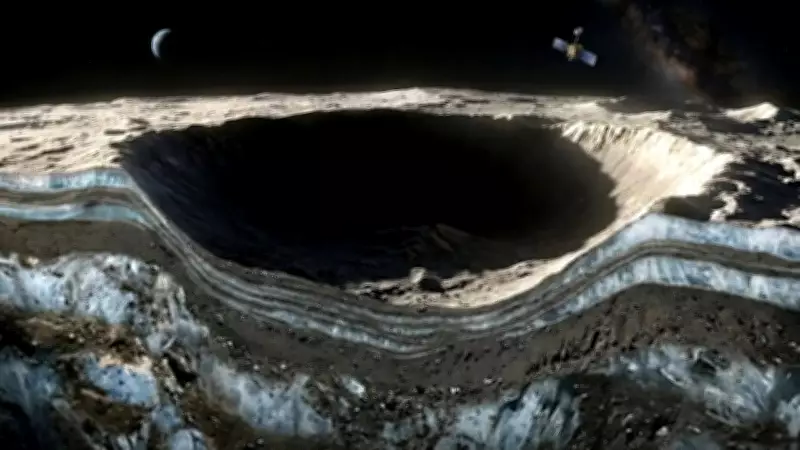
Ice exposed on the lunar surface was found in younger PSRs, which formed around 100 million years ago. In contrast, older PSRs contain buried ice covered with regolith layers. This indicates a continuous, long-term accumulation and gardening process at the lunar poles, where water ice has been added, covered, and preserved for 1.5 billion years.
How Axial Shifting Created the Moon's Cold Traps
The accumulation of water ice is influenced by the Moon's current position within a gravitational field, but its 'true polar wander' has also played a crucial role. As the Moon's mass distribution changes with rotation, its axial angle shifts relative to the orbital plane, altering the extent of PSRs.
NASA's Goddard Space Flight Centre notes that PSRs act as cold traps, with temperatures below 110 Kelvin (-261 degrees Fahrenheit), allowing water ice and molecules to remain stable for billions of years. With the Moon's axial tilt changes increasing the number of regions in total darkness, the volume of water ice in PSRs continues to grow through trapping processes.
Turning Ancient Ice into Life Support for Space Exploration
Researchers have verified the existence of a reservoir of ice approximately 1.5 billion years old. This discovery opens new avenues for NASA's Artemis exploration program. The ice is not concentrated in one large area but is dispersed in varying amounts, mixed with soil, and found at different depths depending on its formation age.
Due to the unique nature of this resource, extraction will require careful and precise methods. Beyond scientific research, the ice serves as a critical in-situ resource. It can be electrolyzed to produce hydrogen fuel and oxygen for rockets, as well as oxygen for life-support systems on human missions. Thus, lunar surface ice is poised to become a strategic propellant reserve or 'gas station' for missions to Mars and beyond.