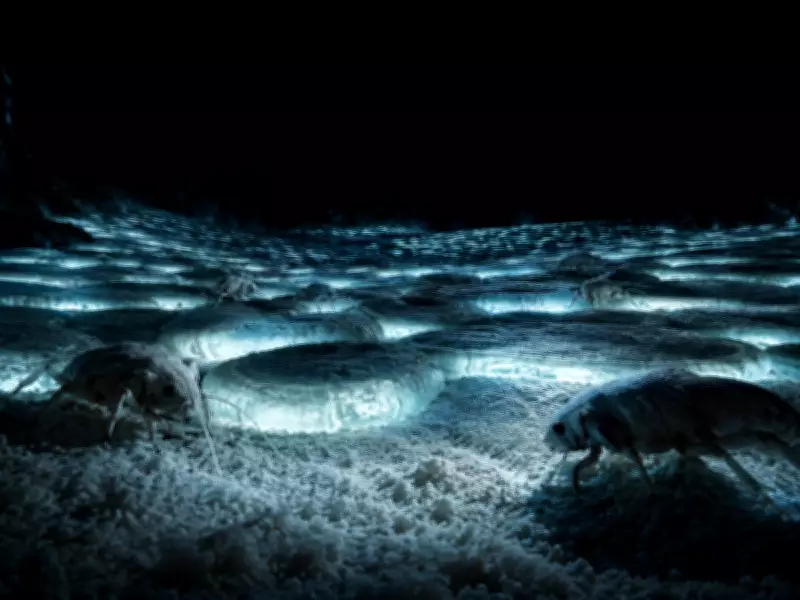
In 1986, during land exploration along the Black Sea coastline for a new power station site, workers stumbled upon a remarkable discovery: a completely sealed cave. Instead of the intended location, they found Movile Cave, an ecosystem isolated from the surface for approximately 5.5 million years. This unique habitat hosts organisms that live entirely without sunlight.
For most life on Earth, sunlight is essential, as surface ecosystems depend on it for energy production. However, Movile Cave demonstrates that complex ecosystems can thrive without sunlight. This completely dark environment contains toxic gases like hydrogen sulfide, methane, and ammonia, with extremely low oxygen levels.
An Unexpected Discovery of a New World
The discovery of Movile Cave astonished scientists, who recognized it as a perfect natural laboratory, having been sealed off from the outside world for millions of years. The cave remained isolated from atmospheric air for the last 5 to 6 million years. It harbors not just a few lost insects but a whole community of organisms adapted to severe conditions.

According to a study published in PubMed, the water in Movile Cave contains sulfur, methane, and ammonia—substances toxic to ordinary flora and fauna. Yet, certain microorganisms thrive there.
Chemistry Rules Everything Inside
The key process sustaining Movile Cave is chemosynthesis. Since photosynthesis cannot occur due to lack of light, microorganisms become primary producers. They obtain energy by breaking down toxic compounds in the water.
Research in the ISME Journal identified genes of sulfur-oxidizing bacteria and archaea. These microorganisms form a biofilm covering the water surface, acting like grass in the cave and forming the basis of the ecosystem. Additionally, nitrogen-fixing bacteria that destroy ammonia and nitrites provide energy sources. Thus, the system uses Earth's compounds rather than sunlight.
Why Was the Cave Hidden?
Movile Cave remained hidden due to physical and chemical isolation. It lacks vertical caves or fissures leading to the surface, and its water comes from deep underground wells, not rainfall.
A 2023 study in Scientific Reports confirmed the cave's sealing. Scientists tested water in Movile Cave and found no radioactive isotopes from the 1986 Chornobyl nuclear disaster. This absence of contamination proves that surface water does not penetrate this underground world. Movile Cave is a true closed ecosystem, unaffected by surface environmental events.
A Sealed Ecosystem with Complex Food Webs
Contrary to expectations, this ecosystem includes more than microscopic fungi and bacteria. They serve as food for smaller cave creatures, which are preyed upon by other species. Dozens of animal species, many found nowhere else, inhabit Movile Cave, including blind spiders, water scorpions, centipedes, and leeches. Having lived in darkness for millions of years, these creatures are often blind or have reduced eyes and lack pigmentation.
Movile Cave has opened new perspectives on life's requirements on Earth. It remains important for microbiology, metabolism studies, and even space exploration. Scientists continue research in Movile Cave to study life on other planets. The cave is a testament that Earth still holds many secrets.