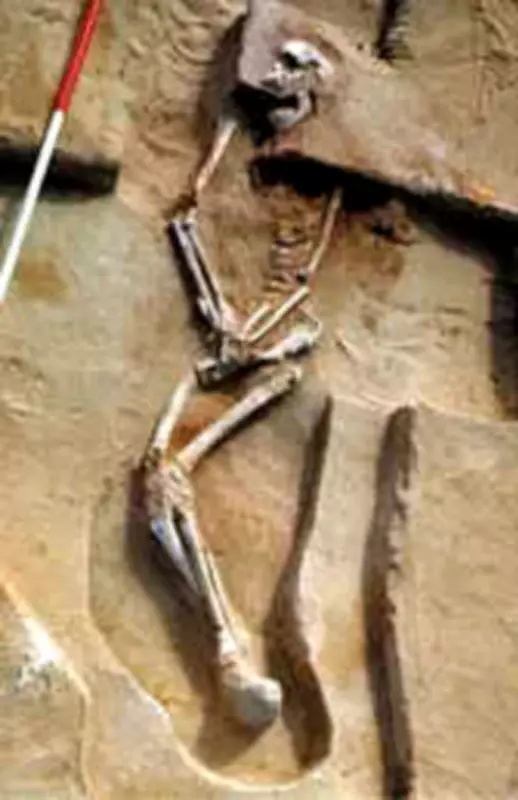
A Discovery That Changed History
Today, the Willandra Lakes region in New South Wales presents a somber landscape, dotted with dried-up lake beds and the impressive formations known as the Walls of China. Yet 42,000 years ago, this area teemed with life. The stark contrast between then and now became evident in 1968 when geologist Jim Bowler made a groundbreaking discovery. While studying soil layers and climate history, he walked atop a sand dune, and the wind blew away charcoal remains from a human skeleton.
This was no ordinary archaeological find. Bowler had stumbled upon Mungo Lady, and her remains would forever alter our understanding of human culture. The bones were not just ancient; they were clearly burnt. This indicated that her community had performed a deliberate, multi-stage ritual. The discovery proved that tens of thousands of years before the great civilizations of Egypt or Mesopotamia, people in Australia were practicing the world's earliest known cremation.
Scientific Validation
According to an article in Nature titled "New ages for human occupation and climatic change at Lake Mungo, Australia," the cremation dates to approximately 40,000 to 42,000 years ago. The authors go beyond establishing dates, highlighting the ability of early humans to thrive during climatic changes.

A Ritual That Turned History Upside Down
It was once widely accepted that sophisticated religious beliefs and burial rituals appeared much later in human evolution. Mungo Lady made that assumption obsolete. The cremation process involved three steps: burning the body, crushing the skeleton, and placing it near a dune. This practice required fire and a collective belief in an afterlife, revealing that ancient humans had emotional ties and funeral traditions.
Another pivotal study in Nature, "Pleistocene Man in Australia: Age and Significance of the Mungo Skeleton," broke down the initial findings. Researchers noted that the remains were tucked into shoreline dunes of an ancient Pleistocene lake. This proved that Australia had been occupied much longer than previously thought, and early inhabitants were developing complex cultures with symbolic behavior.
Mungo Man and Other Discoveries
Not long after Mungo Lady, another discovery emerged: Mungo Man. His burial site featured an elaborate grave design with red ochre covering the body. Together, Mungo Lady and Mungo Man offer a view into the culture of people unheard for 40,000 years—one harnessing fire, the other skilled with ochre.
A Permanent Mark on a Changing World
The story of Mungo Lady is also the story of the landscape. The sand dunes of Lake Mungo acted as a natural vault, protecting the skeletons with layers of silt and sand. Had Bowler arrived five minutes earlier or later, the remains might have been buried deeper or weathered away. It was the perfect convergence of archaeology and geology.
Today, Mungo Lady is more than an artifact; she is an ancestress. The find sparked global debates on the intelligence of Australia's indigenous peoples, proving a centuries-old connection to the land that is primal and spiritual. Lake Mungo is now a World Heritage site.
As Bowler ambled over the sand dunes in 1968, he reminded us that history is not only recorded in books. It can be eroding from a hillside, waiting to be rediscovered. Mungo Lady stands as a powerful symbol of the eternal human need to honor the departed—a ritual that has survived for over 42,000 years.