Planning a trip to Thailand? Then this forbidden trek will greet you with one of the biggest mysteries of nature and will leave you wondering about why no one told you about this earlier! Here is the history and mystery of the Serpent Cave, also known as the Naga Cave.
All About the Mysterious Cave
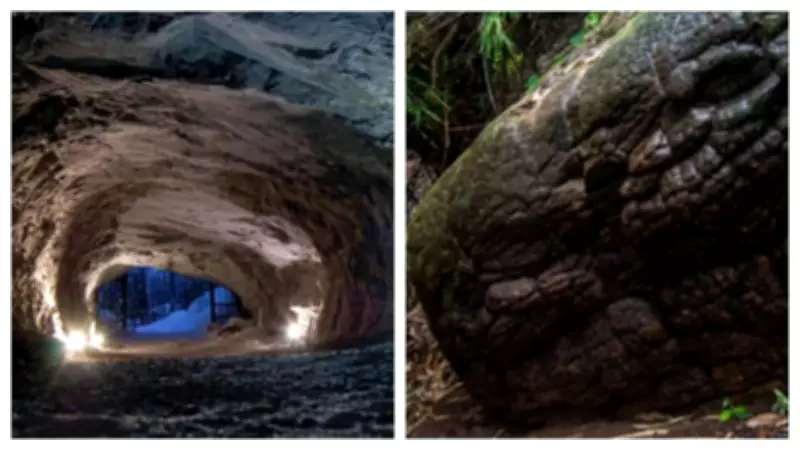
Located deep within the lush green forests of Phu Langka National Park in Thailand's Bueng Kan province lies Naka Cave, also known as Naga Cave. This enigmatic cave feels less like a scene from a mythological novel, challenging the very existence of snakes. The cave was discovered in 2020 and quickly gained global attention due to its bizarre rock formations. The ancient rocks bear a striking resemblance to a coiled snake, complete with scale-like bumps and muscle-like curves. Nearby rocks even resemble the head of a giant serpent.
The Myth of the Cursed King
To locals, the cave is not a mere trick of nature but a place of profound spiritual significance. According to prominent Thai folklore, the formation is the petrified body of King Ue-Lue. Legend holds that the king's grandson fell in love with a beautiful woman who was secretly a Naga, a mythical semi-divine serpent capable of human form. When the king discovered her true nature, he felt deceived and exiled her, deeply humiliating the Naga Kingdom. In retaliation, the furious Naga King led an army to burn down the human kingdom, submerging it into what is now Khong Long Lake. King Ue-Lue himself was cursed, transformed into a massive serpent, and bound to the rocks to sleep for eternity until the curse lifts.

What Science Says
Geologists offer a completely different yet equally fascinating explanation. The "scales" on the rock are a natural phenomenon known as sun-cracked rock. Over 100,000 years ago, the region's sandstone underwent extreme cycles of thermal expansion and contraction, expanding under blazing heat and shrinking during cold nights. This continuous stress caused the outer layers to crack into neat geometric patterns. Over millennia, water erosion polished the edges, giving them the smooth, overlapping look of reptile skin.

Interesting Facts About Naka Cave
- The Trilogy of Snakes: Naka Cave is not alone. The national park hosts three serpent-themed formations, including Nakee Cave and Kinnaree Naka Cave, though Naka is the most famous due to its intact "body."
- The Missing Head: While the main trail features the coiling body and scales, the rock formation resembling a giant python's head is located a short distance from the main cavern entrance.
- The Extinct Titanoboa Theory: When photos went viral, many internet theorists speculated the cave was the fossilized remains of a Titanoboa, the largest known prehistoric snake.
- A Sacred Trek: Reaching the cave requires a steep, challenging 2-kilometer hike taking one to two hours. Because it is considered sacred, visitors pass Buddhist pagodas, and many locals climb purely to pray and make merit.