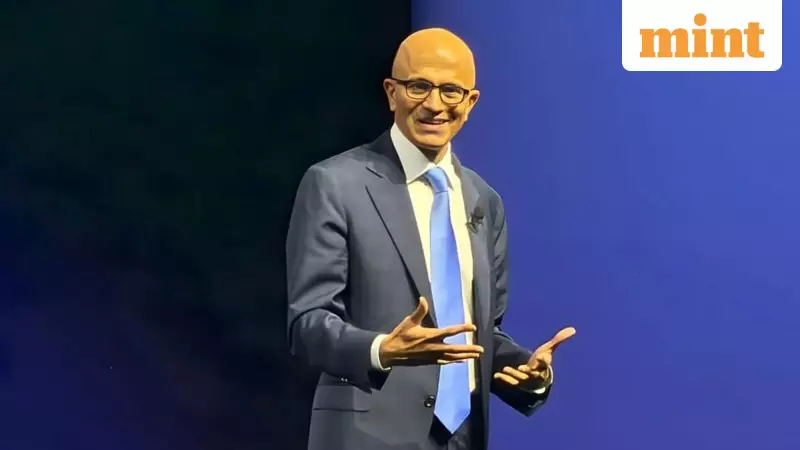
Microsoft's Chief Executive Officer, Satya Nadella, has outlined a critical vision for the future of artificial intelligence, pinpointing 2026 as a "pivotal year" for the technology. In a detailed blog post, Nadella stated that AI is transitioning from a phase of initial discovery to one of "widespread diffusion," marking a significant shift in how the industry perceives and utilises these powerful tools.
The Challenge of 'Model Overhang'
Nadella introduced a crucial concept for the current state of AI development: "model overhang." This term describes a growing gap where the sheer capabilities and sophistication of AI models are advancing faster than our collective ability to harness them for tangible, real-world results. He candidly admitted that while the technology's potential is spectacular, the industry is now learning to distinguish between "spectacle" and "substance."
"We are still in the opening miles of a marathon. Much remains unpredictable. Amidst this 'model overhang,' where capability is outpacing our current ability to use it to have real world impact," Nadella wrote. He emphasised that the journey ahead is long and requires a more deliberate focus on application over mere advancement.

Nadella's Prescription for Meaningful AI
To bridge this gap between potential and practice, the Microsoft CEO laid out a multi-pronged approach for the industry to adopt.
First, he called for a fundamental evolution in design philosophy. Referencing Steve Jobs's famous "bicycles for the mind" analogy for computers, Nadella argued that AI tools must be designed as supports for human thinking, not as substitutes. The goal should be to create "cognitive amplifiers" that augment human intelligence and collaboration, moving beyond debates about the quality of AI output to establish a new equilibrium in our "theory of the mind."
Second, Nadella stressed the need to move from building isolated AI models to constructing comprehensive systems around them. He acknowledged that AI still has "jagged edges" or limitations. The solution, he proposed, lies in engineering structures that allow multiple models and AI agents to work together cohesively. These systems would need to incorporate memory, safe tool use, and clear entitlements to become truly useful in everyday scenarios.
Deliberate Choices for Societal Acceptance
The final pillar of Nadella's outlook focuses on purpose and resource allocation. He warned that the industry must make "deliberate choices" about where to apply scarce energy, computing power, and talent. For AI to gain broad societal acceptance, it must demonstrably solve real problems for people and the planet, showing concrete outcomes.
"Ultimately, the most meaningful measure of progress is the outcomes for each of us. It will be a messy process of discovery, like all technology and product development always is," Nadella noted. He underscored that building consensus on these priorities is an urgent issue for developers, companies, and policymakers alike.
Published on 30 December 2025, Nadella's insights set the stage for 2026 as a defining period where the AI narrative must shift from raw capability to responsible, impactful, and human-centred integration.