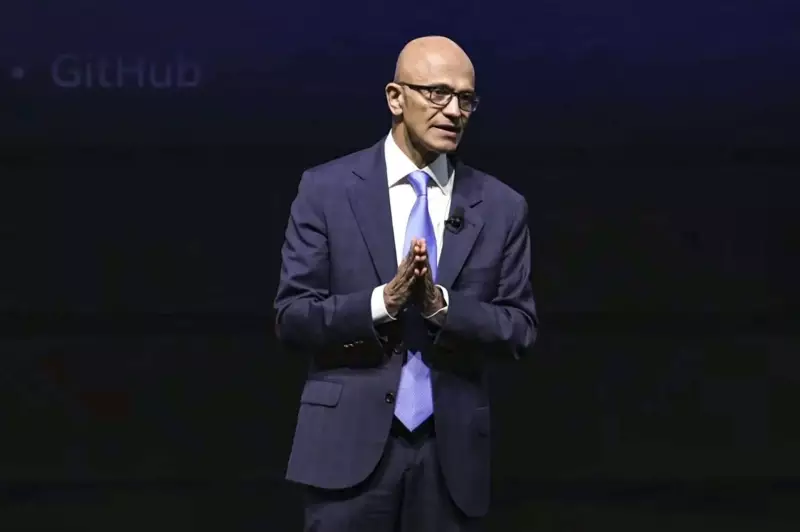
In a candid year-end message, Microsoft's Chief Executive Officer Satya Nadella has set a critical deadline for the artificial intelligence industry. He believes 2026 will mark a definitive turning point, not due to more advanced models, but because the sector must finally answer a fundamental question: what is it actually building AI for?
Beyond the Spectacle: Nadella's Three Uncomfortable Priorities
Nadella's reflection cuts through corporate optimism to lay out three pragmatic and challenging priorities. He argues the industry's "spectacle" phase is over, replaced by harder questions about substance. First, companies must decide if AI will amplify human potential or simply replace it. Second, they need to build complete systems that function reliably outside controlled lab environments. Third, and perhaps most difficult, the industry must make tough calls about where to deploy AI's massive resource demands.
"What matters is not the power of any given model, but how people choose to apply it to achieve their goals," Nadella wrote. He advocates for a philosophical reset, treating AI as scaffolding that supports human capability, not a substitute for it.

The Problem of "Model Overhang" and the Path to Real-World Use
The Microsoft CEO identified a core issue he terms "model overhang"—where AI's capability has outrun its proven usefulness. New models keep shattering benchmarks, yet the gap between impressive demos and practical, everyday applications continues to widen.
The solution, according to Nadella, isn't building ever-larger models. Instead, the focus must shift to engineering complete systems that orchestrate multiple AI agents, handle memory and permissions, and operate safely in real-world chaos. "We have learned a lot in terms of how to both keep riding the exponentials of model capabilities, while also accounting for their 'jagged' edges," he explained. The next phase requires smoothing out these inconsistencies to make AI reliable for daily use.
The Unasked Resource Question: Justifying AI's Heavy Cost
Nadella pushes the conversation into uncomfortable territory by addressing AI's staggering appetite for energy and computing power. The industry, he suggests, has not seriously debated how these finite resources should be prioritized. Should they tackle climate change and transform healthcare, or be used to generate marketing content?
"For AI to have societal permission it must have real world eval impact," Nadella stated. Stripping away the corporate language, he asserts that AI must justify its enormous cost—in carbon, electricity, and talent—through measurable benefits that people genuinely value. He frames this as fulfilling computing's original promise: empowering people to achieve more.
A Survival Strategy, Not Just Philosophy
This message is deeply personal for Nadella and strategic for Microsoft. He is driving the company through its most aggressive transformation, having invested over $13 billion in OpenAI and launched Microsoft's own AI models. Reports indicate he has told executives to commit fully or leave, warning in a recent memo that "some of the biggest businesses we've built might not be as relevant going forward."
The pressure is palpable. Nadella recently admitted he is "haunted" by the prospect of Microsoft not surviving the AI era, drawing a stark comparison to Digital Equipment Corporation (DEC), which dominated minicomputers before vanishing. He invoked DEC's collapse in response to an employee's complaint about the company feeling "colder," noting there's "no permission for any company to exist forever."
Thus, when Nadella talks about deliberate choices by 2026, he is not merely mapping industry trends. He is outlining Microsoft's survival strategy for an era where even fifty-year-old tech giants can disappear if they miss the next technological wave. The road, as he acknowledges, will be messy, but getting these fundamentals right could make AI "one of the most profound waves of computing yet."