

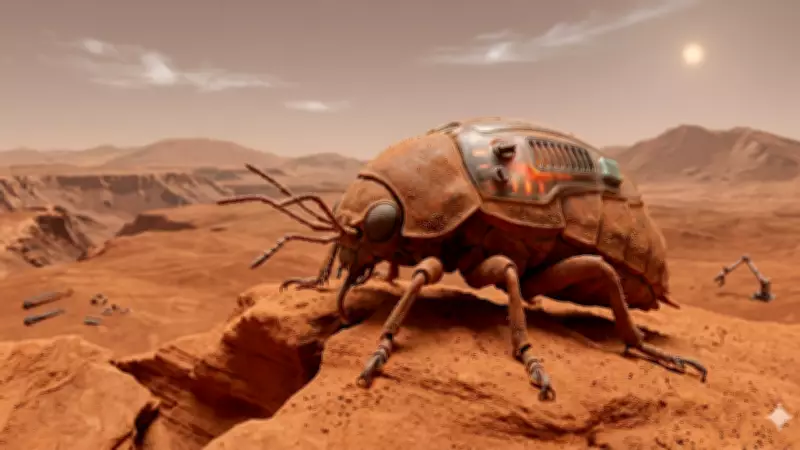
NASA Rover Images Spark Intrigue Over Alleged Insect and Predator Life on Mars
In recent days, the discovery of what appear to be "winged insects" and predator-like life forms in images captured by NASA's rovers on Mars has both fascinated and perplexed scientists in equal measure. The notion of insects flitting across the planet's surface or lizard-like creatures concealed within Martian dust presents an undeniably captivating idea. However, despite multiple instances where researchers have identified such forms in rover photographs, the broader scientific community remains deeply skeptical.
This skepticism stems from Mars being one of the most extensively studied planets in our solar system, yet no conclusive evidence of complex life has been found. The claims primarily originate from interpretations of images taken by NASA's Curiosity rover and other missions, which have been scrutinized by independent analysts.
Entomologist's Analysis Fuels Claims of Extant Martian Life
Entomologist William Romoser has been at the forefront of these assertions, analyzing publicly available rover images to suggest the presence of insect-like and reptile-like organisms on Mars. In his work titled "Evidence of Extant Insect-Like Organisms on Mars" and supplemental materials, Romoser argues that certain shapes exhibit features resembling wings, wing flexion, and structured legs.

He has boldly stated that "there has been and still is life on Mars," presenting his observations at meetings of the Entomological Society of America. Romoser notes that some forms appear to be in motion or interacting with their environment, adding credibility to his claims. These assertions have gained renewed attention as higher-resolution images from Mars become accessible, enabling more detailed examination by researchers worldwide.
Scientific Explanation: Pareidolia and the Challenge of Interpretation
Despite the excitement surrounding these claims, the majority of scientists outright reject them. The primary issue involves a psychological phenomenon known as pareidolia, where humans instinctively perceive familiar patterns—such as animals or faces—in random objects or shapes.
Experts contend that what appear to be bugs or lizards are likely rocks shaped over millions of years by wind, dust, and erosional processes on Mars' surface. They emphasize that finding "suggestive shapes in NASA photos" does not constitute evidence of life. In planetary science, pareidolia presents significant challenges for researchers analyzing surface images, often leading to misinterpretations.
Furthermore, no missions to Mars have discovered traces of insectoid life forms or animals. Current explorations focus on identifying microbial life or signs of ancient biological activity, not complex organisms.
What NASA Research Actually Reveals About Martian Life
While the insect theory lacks confirmation, NASA's studies have yielded remarkable insights. For instance, the Perseverance rover's discovery of "Cheyava Falls" has been highlighted as a potential indicator of ancient life. Scientists suggest such formations point to chemical reactions that could have supported microbial life billions of years ago, though alternative explanations exist.
Rovers have also detected organic materials and geological features formed by water, essential elements for life's development. However, these findings do not prove that life currently thrives on Mars. The scientific consensus maintains that no evidence exists for insects, predators, or any complex life forms on the Red Planet.
The Bigger Picture: Curiosity, Caution, and the Quest for Truth
The idea of flying insects on Mars captures the imagination, but scientific inquiry must prioritize evidence over interpretation. These theories reflect a deeply human hope: that life exists beyond Earth and is not confined to our planet. Mars remains a prime candidate for discovering primitive microorganisms, which could revolutionize our understanding of life in the universe.
For now, Mars retains its mysteries, and while images may spark wonder, the reality must be validated through rigorous scientific investigation. The debate underscores the balance between curiosity and caution in the ongoing search for extraterrestrial life.






