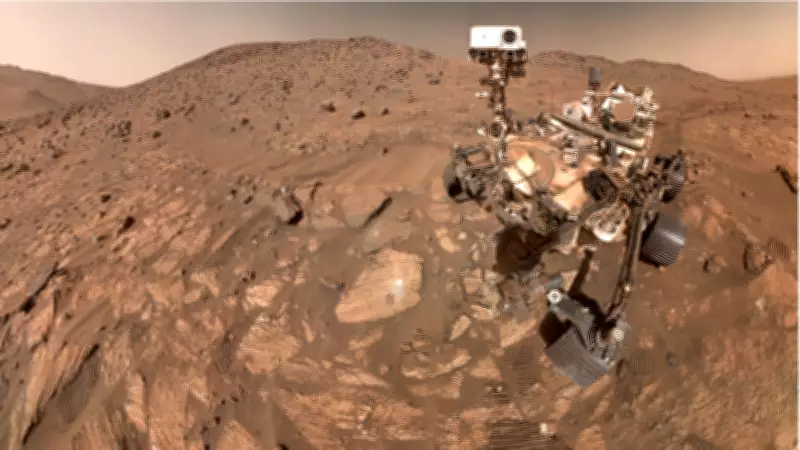
NASA's Perseverance Rover Uncovers Ancient River Delta Buried Deep Beneath Mars Surface
In a groundbreaking discovery that reshapes our understanding of the Red Planet, NASA's Perseverance rover has detected the underground remains of an ancient river delta on Mars. This finding offers some of the strongest evidence yet that water once flowed across the Martian surface, potentially creating environments suitable for life.
Deep Underground Discovery Using Advanced Radar Technology
The remarkable discovery was made using Perseverance's ground-penetrating radar instrument, which revealed hidden geological features beneath the Martian terrain that had remained invisible to surface observations. The six-wheeled rover identified these structures up to 115 feet (35 meters) below the surface while traveling approximately 6.1 kilometers across Jezero Crater in Mars' northern hemisphere.
Scientists believe this crater once held a substantial lake that was fed by flowing rivers billions of years ago. The latest data, collected between September 2023 and February 2024 over 250 Martian days, represents the deepest radar observations made by the rover to date.

Ancient River Delta Features and Geological Significance
Researchers found layered sediments and eroded surfaces typical of a river delta formation. They observed a fan-shaped deposit characteristic of where a river meets a larger body of water like a lake. These features strongly suggest that Jezero Crater once hosted a stable, water-rich environment capable of supporting geological processes similar to those on Earth.
The buried delta is estimated to be between 3.7 and 4.2 billion years old, indicating it formed relatively early in Mars' history, shortly after the planet itself was formed about 4.5 billion years ago. Scientists noted that this underground delta predates a nearby surface formation known as the Western Delta, which is younger in comparison.
Revolutionary Radar Instrument Provides Detailed Subsurface Mapping
The findings were made possible by Perseverance's RIMFAX instrument, which sends radar signals below the surface and records how they bounce back. This technology allows scientists to create detailed three-dimensional maps of subsurface structures, revealing geological features that would otherwise remain hidden.
"It's very exciting that RIMFAX was able to provide such a detailed view of these deposits, and thus help solve the puzzle of their origin," said UCLA scientist David Paige. He emphasized that ground-penetrating radar is proving to be an invaluable tool in studying planetary geology and understanding Mars' ancient history.
Implications for Past Life and Water History on Mars
Scientists consider this discovery particularly significant because water is considered essential for life as we know it. Mars, now cold and dry with a thin atmosphere, is believed to have once had a thicker atmosphere and warmer conditions that allowed liquid water to exist on its surface.
"From the features mapped by RIMFAX, we believe that Jezero Crater hosted an ancient water-rich environment, capable of biosignature preservation that existed prior to the formation of Jezero's Western Delta," explained UCLA planetary scientist Emily Cardarelli. A biosignature refers to chemical or physical evidence of past or present life.
On Earth, river deltas are known to trap sediments and create conditions suitable for microbial life preservation, making this discovery especially promising for astrobiological research.
Building on Previous Mars Discoveries
The latest discovery adds to earlier findings from Perseverance's mission. In 2024, scientists reported that a rock sample collected in Jezero Crater contained a possible biosignature, though researchers noted it could also have formed through non-biological processes. That rock was dated to between 3.2 and 3.8 billion years old.
Since landing in 2021, Perseverance has been systematically exploring Jezero Crater, where scientists have long suspected ancient rivers once flowed into a substantial lake. The rover's findings continue to build a compelling picture of Mars' watery past.

International Context and Broader Scientific Implications
These findings align with other recent discoveries about Mars' ancient water history. Chinese scientists previously reported that their Zhurong rover detected underground features resembling ancient ocean shorelines on Mars, suggesting widespread water activity in the planet's distant past.
The discovery of the buried river delta represents a major advancement in our understanding of Mars' geological history and its potential for having hosted life. As Perseverance continues its mission, scientists anticipate further revelations about the Red Planet's ancient environments and their implications for the search for extraterrestrial life.