NASA's Most Stunning Galaxy Images: Cosmic Art Reveals Universe's Secrets
Humanity has always been fascinated by the vast expanse of space, and thanks to NASA's powerful telescopes, we can now witness the universe with breathtaking clarity. Astronomers have captured images of galaxies that resemble cosmic masterpieces, using instruments like the Hubble Space Telescope. These celestial wonders are not only visually stunning but also provide crucial insights into star formation, galactic interactions, and the evolution of the universe over billions of years. From ring-shaped galaxies born from cosmic collisions to spiral giants teeming with young stars, each discovery tells a unique story. This exploration merges scientific inquiry with sheer awe, allowing us to peer beyond our Milky Way into the depths of the cosmos.
The Andromeda Galaxy – Our Closest Galactic Neighbor
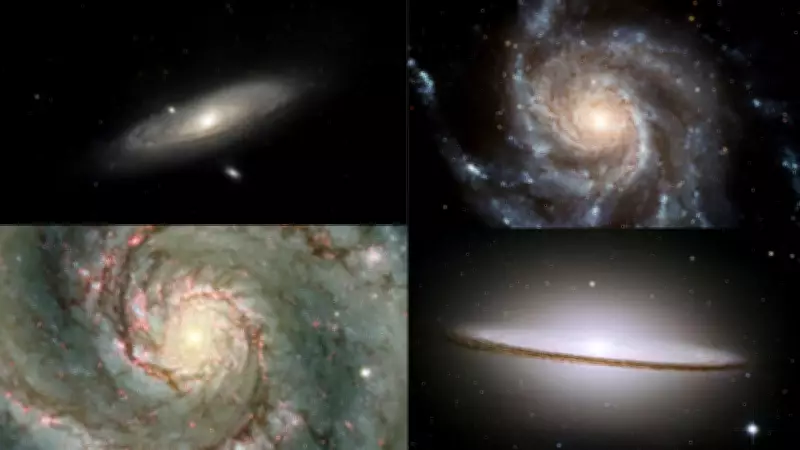
The Andromeda Galaxy, also known as M31, is the closest large galaxy to the Milky Way and stands as one of the most extensively studied objects in astronomy. Located approximately 2.5 million light-years away, it is visible to the naked eye under dark skies. Over more than a decade, NASA's Hubble Space Telescope compiled an enormous mosaic of this galaxy, resulting in an image that reveals intricate structures throughout Andromeda's spiral arms, featuring hundreds of millions of stars. Astronomers focus on Andromeda because it offers a close-up view of a galaxy similar to our own. By analyzing its stars and satellite galaxies, researchers aim to uncover how massive galaxies expand and transform over billions of years, shedding light on galactic evolution.
The Pinwheel Galaxy – A Grand Design Spiral Marvel
The Pinwheel Galaxy, designated Messier 101, serves as a magnificent example of what astronomers term a grand design spiral galaxy. Situated about 21 million light-years away, it is distinguished by its massive, well-defined spiral arms. NASA and the European Space Agency released a detailed Hubble image that stands as one of the most complex depictions of this galaxy. The image showcases numerous star-forming regions scattered across its expansive disk. The Pinwheel Galaxy is characterized by vast clouds of gas and dust where new stars continuously form, creating bright pink and blue areas that resemble cosmic fireworks. These glowing star nurseries highlight the dynamic processes of stellar birth within this celestial structure.

The Sombrero Galaxy – A Hat-Shaped Cosmic Wonder
The Sombrero Galaxy, or Messier 104, is one of the most unique galaxies captured by NASA's telescopes, earning its name from its resemblance to a broad-rimmed Mexican hat when viewed from Earth. NASA describes it as having a brilliant white, bulbous core encircled by thick dust lanes. A gentle glow emanates from the galaxy's core, composed of billions of old stars that form its massive central bulge. Simultaneously, dark dust bands create a striking ring across the galactic disk. Researchers have discovered that the Sombrero Galaxy contains roughly 2,000 globular star clusters, significantly more than those orbiting the Milky Way. The dramatic contrasts between light and shadow make this one of the most iconic images in astronomical photography.
The Cartwheel Galaxy – Beauty Born from a Cosmic Collision
Among the most spectacular images from NASA's Hubble telescope is the Cartwheel Galaxy, which features a huge glowing ring of stars instead of a typical spiral structure. NASA scientists explain that this unique shape resulted from a violent collision where a smaller galaxy crashed into the center of a larger one. This event generated shock waves that propagated outward like ripples in water. As these shock waves passed through gas and dust, they triggered massive star formation. NASA vividly compares this process to a rock tossed into a lake, creating ripples that ignite explosions of star birth. The Cartwheel Galaxy is one of the most striking galactic structures ever photographed, with clusters of young blue stars glowing brightly within its ring.

The Whirlpool Galaxy – A Classic Spiral Masterpiece
The Whirlpool Galaxy, known as M51, is one of the most striking spiral galaxies ever captured on camera, located approximately 30 million light-years away. It is renowned for its bright clusters of young stars and sweeping spiral arms. NASA notes that this galaxy is one of the brightest and most picturesque galaxies in the sky. Scientists have observed interactions between the Whirlpool Galaxy and its smaller companion, NGC 5195. According to NASA's Jet Propulsion Laboratory, the gravitational pull from this interaction disturbs the gas and dust within the spiral arms, initiating the formation of new stars. This cosmic encounter produces clusters of brilliant blue stars and glowing hydrogen regions, contributing to the Whirlpool Galaxy's stunning appearance in telescope images.