

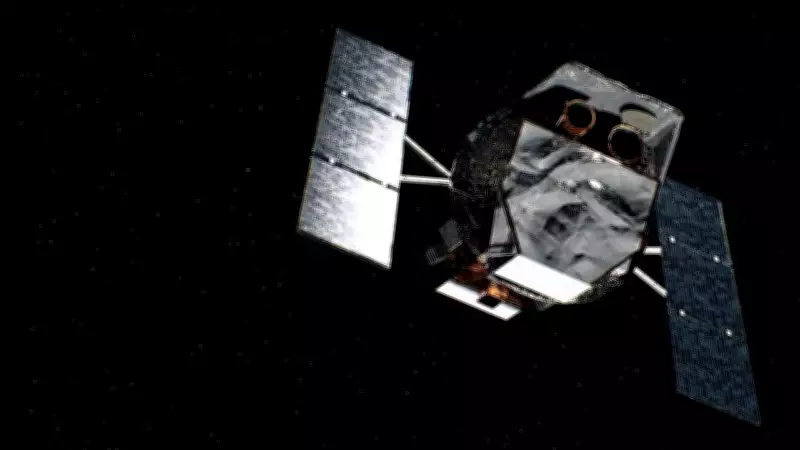
NASA's Swift Observatory in Peril: $30 Million Robotic Rescue Mission Planned for 2026
The race is intensifying to rescue one of NASA's most critical space telescopes from a looming 90 percent re-entry risk. Currently ensnared in a 'death spiral' triggered by heightened solar activity, the Neil Gehrels Swift Observatory has descended to an altitude of 400 kilometres, placing it in imminent danger of a fiery crash back to Earth.
Science Behind the Spacecraft's Descent
The term 'falling' suggests a rapid drop, but it actually results from invisible forces in the upper atmosphere. The Neil Gehrels Swift Observatory is now a passive victim of 'Atmospheric Drag.' We are in Solar Cycle 25, an active phase with significant solar flares that heat the thermosphere, causing it to expand outward into the satellite's orbital path. This increased atmospheric density creates more resistance, acting as a braking system that decelerates the spacecraft. As the satellite slows, its descent accelerates, leading to a downward spiral that culminates in a hot re-entry.
The $30 Million Plan to Save Swift
To avert disaster, NASA has awarded a $30 million contract to Katalyst Space Technologies, based in Arizona, for the first-ever 'robotic rescue' of a spacecraft. This mission, part of NASA's official 'Ignition' program, involves launching a special spacecraft called 'LINK' via a Pegasus XL rocket in June 2026. The rescue will use an 'Air Launch' method, with the rocket deployed from the 'Stargazer' L-1011 carrier aircraft at 40,000 feet for rapid interception. LINK will autonomously dock with Swift, using robotic arms to capture it via structural bolts or the launch adapter ring, as the telescope lacks traditional docking ports. After capture, LINK will fire its rockets to boost Swift back to a stable orbit of about 600 kilometres, extending its life by up to 10 years.

What NASA Stands to Lose If the Rescue Fails
If this high-risk mission fails, the global scientific community will lose its primary 'cosmic dispatcher.' Since NASA suspended Swift's science operations in February 2026 to conserve fuel, there is already a gap in real-time data. Swift is uniquely capable of detecting Gamma Ray Bursts (GRB), the largest known explosions in the universe, and automatically redirects its telescopes within seconds to study them. It then dispatches coordinates to other telescopes like Hubble and James Webb for further analysis. Currently, no other NASA missions in development match Swift's reactivity or sensitivity, meaning its loss would severely hinder our understanding of black holes and supernovae.
This rescue represents a significant shift for NASA toward commercial satellite-servicing 'tow trucks,' highlighting the agency's innovative approach to preserving vital space assets amid growing challenges from solar activity.






