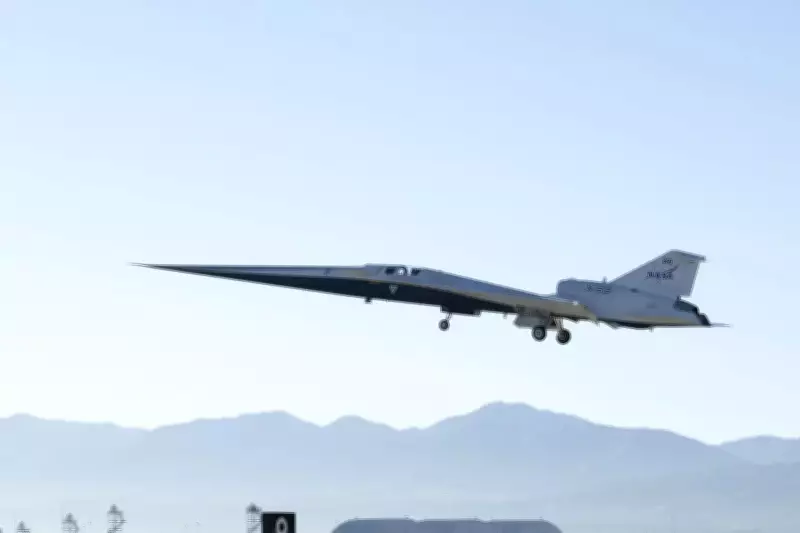
The comfort of travelling from a faster commercial flight over land is arguably closer than ever before. For a very long time, the idea of ultra-fast commercial travel felt like an unreachable luxury or a privilege reserved strictly for military personnel. While engineers mastered the art of building incredibly fast jet engines decades ago, a massive roadblock remained: the window-shaking, thunderous noise created whenever an aircraft pushes past the speed of sound. Today, a striking new aviation project is taking flight in an attempt to tackle this issue by transforming a loud atmospheric blast into a soft, subtle murmur.
Transforming Supersonic Flight
This ambitious engineering shift focuses entirely on a unique experimental aircraft built to challenge the traditional boundaries of aviation. Developed under a dedicated program to safely reintroduce high-speed civilian travel, the plane features a highly unconventional aerodynamic body. By changing how high-velocity air flows across the exterior frame, design teams are working to alter the fundamental physics of supersonic flight. If these trials prove successful, they could provide the necessary data to convince global regulators to lift long-standing bans on rapid travel over land, potentially opening up an entirely new world for business travellers and frequent flyers alike.
The Engineering Puzzle of a Cockpit with No Direct Forward View
To achieve such a dramatic drop in noise, creators had to throw out the standard aircraft construction playbook completely. As documented in a recent technical update hosted on the official NASA Armstrong Flight Research Center site, the nose of the X-59 is so exceptionally elongated and sharp that it blocks the entire forward view from the cockpit. A pilot looking straight ahead from their seat would see nothing but the metallic upper surface of their own plane. Because of this structural reality, the aircraft was built without a traditional forward-facing windscreen, a decision that required an entirely fresh approach to basic navigation.

To solve this severe visibility problem, engineers developed the eXternal Vision System (XVS). As explained by the NASA Armstrong Flight Research Center, this setup utilises a complex series of high-definition cameras facing forward. These cameras send real-time video to an augmented reality screen positioned directly in front of the pilot. Consequently, the pilot can safely navigate outside the vehicle through this advanced tech.
This customised electronic feed digitally processes the image to completely remove the obstruction of the long nose, giving the operator a clear view of the oncoming airspace. This smooth combination of advanced cameras and display screens allows for highly accurate steering during complex takeoff and landing manoeuvres without the need for a traditional windscreen.
Gathering the Human Data Needed to Lift a Fifty-Year Ban
This sleek, windowless jet's main goal isn't just about showing that an unusual design can fly safely. According to NASA's Quesst program mission brief, the real aim is to collect important feedback from communities about noise perception. Back in the day, governments put strict noise bans in place due to annoying sonic booms that could also potentially cause structural vibrations. Now, NASA has compared the target sound to a car door closing in the distance.
Under the framework established by the NASA Quesst mission, the aircraft will eventually be flown directly over several chosen neighbourhoods across the United States. As the jet flies at altitude with a reduced sonic thump, researchers will carefully monitor and survey the reactions of the general public living beneath the flight path. All of the gathered opinion polls, noise measurements, and behavioural datasets will eventually be handed over to international aviation regulators. By providing solid, real-world proof that supersonic transit can be more neighbourly, this research hopes to help establish a fresh set of noise rules, could support future faster commercial routes.