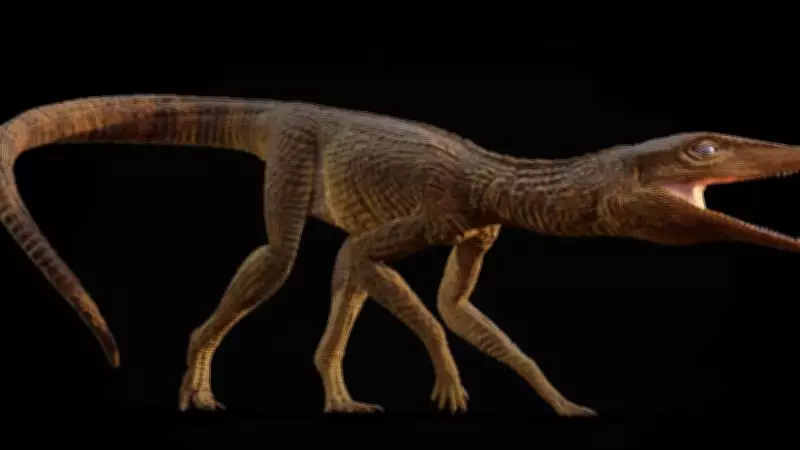
A newly identified ancient crocodile relative from Britain is providing scientists with a clearer picture of life more than 200 million years ago. The species, preserved in rocks for approximately 215 million years, does not resemble the slow, water-loving crocodiles familiar today. Instead, it appears to have been a fast-moving land animal, built for speed and agility. Researchers suggest it likely hunted small reptiles and early mammals across dry, harsh landscapes that once covered parts of southern Britain. The discovery has also gained attention due to its unusual naming, which connects deep prehistoric history with a modern classroom in Wales.
New Ancient Crocodile Species Discovered in Britain
According to the Natural History Museum, the animal has been named Galahadosuchus jonesi, and it belongs to a group known as early crocodylomorphs. These are distant relatives of modern crocodiles and alligators, part of the broader lineage called Crocodylomorpha. Unlike today's crocodiles, this species did not have a bulky body or short limbs designed for swimming. Instead, it had long, slender legs and a lightweight build. Scientists say it probably moved quickly, almost like a reptilian greyhound. It would have lived entirely on land and seems to have been an active predator rather than an ambush hunter.
Environment and Lifestyle
The environment it inhabited during the Late Triassic period was vastly different from modern Britain. It was hotter, drier, and more open, with scattered vegetation and harsh seasonal conditions. The landscape would not have supported large wetlands like those seen today. Life had to move, adapt, and survive in shifting conditions. This agile predator likely thrived in such challenging terrain, chasing down prey with speed and agility.

Fossils Found in Wales and Southwest England
The fossil was unearthed from fissure beds in south Wales and southwest England, including areas around Gloucestershire. A fissure is a natural crack in limestone through which organisms, such as reptiles, were occasionally trapped or transported during floods. Over time, sediments accumulated within the fissure, resulting in their preservation. Other early members of the crocodylomorph family, such as Terrestrisuchus, have been discovered in these fissure beds. Terrestrisuchus had been studied previously and classified as an early ancestor of the crocodile family. However, when the new fossil was examined, certain features led scientists to realize it was an entirely new discovery. These bones had minor differences from those of similar animals, but the differences were significant enough to suggest a new creature.
How Scientists Identified a New Species
The scientists conducted a comparison of these fossils against other known primitive cousins of crocodiles. Skull shapes, limb ratios, and bones were among the aspects analyzed. Altogether, 13 key distinctions were found between these fossils and others. These distinctions did not seem like much at first glance, but they were sufficiently consistent for the scientists to conclude that a new species had been discovered. Such subtle yet essential distinctions are typically used by paleontologists in the discovery process. According to the lead scientist of the group, Ewan Bodenham, a PhD student at both the Natural History Museum, London, and University College London, the purpose of the work was to establish whether the discovered fossil belonged to a previously identified species.

The Story Behind the Unusual Name Galahadosuchus jonesi
The name Galahadosuchus jonesi carries both mythological and personal meaning. The first part, Galahad, refers to a knight from Arthurian legend known for purity and moral strength. Scientists said this reflected the animal's upright posture compared to modern crocodiles. The second part of the name honors David Rhys Jones, a schoolteacher from Wales. He taught at Ysgol Uwchradd Aberteifi in Cardigan and once taught the lead researcher during his school years. Bodenham reportedly said that Mr. Jones was a strong influence during his education. He described him as someone who explained science clearly, stayed genuinely interested in the subject, and challenged students to do their best. He also mentioned that the teacher had a strong sense of humor and made learning enjoyable. It is not common for schoolteachers to be immortalized in the names of ancient animals.