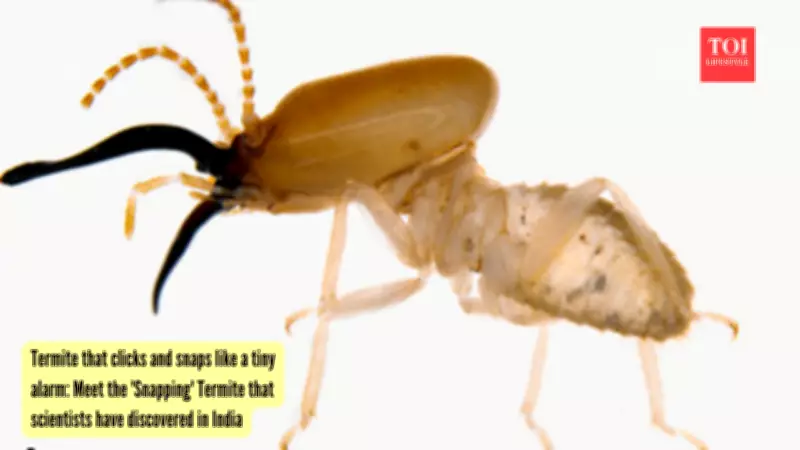
Termites are perhaps the least welcome insects in our homes, silently destroying expensive furniture and woodwork. However, a newly discovered termite species 'snaps' its jaws, making it unique. The snapping termite, scientifically named Pseudocapritermes novus, was found in the Chapramari Wildlife Sanctuary in West Bengal by a team of Indian scientists.
Discovery of the Snapping Termite
Researchers from the Zoological Survey of India, the University of Calcutta, and the Church Missionary Society College collaborated on this discovery, published in the Journal of Insect Biodiversity and Systematics. The termites were collected from soil beneath a fallen Sal tree log. The team examined their morphology under a microscope and analyzed mitochondrial DNA to determine their evolutionary relationships.
Unique Features of Pseudocapritermes novus
What sets this species apart is its asymmetrical, snapping jaws used for defense and alarm signals. Compared to its closest relative, P. bhutanensis, the new species has a strongly bent left mandible with an inward-curving tip, a rounder swollen section beneath its beak, longer and wider lower mouthparts, and prominent spurs on its front legs.

Ecological Role and Naming
Unlike destructive termites, Pseudocapritermes novus feeds on soil and decayed plant matter, enriching the soil and indicating healthy, fertile ground. The species name 'novus' is Latin for 'new.' India now has five recorded species of Pseudocapritermes. Interestingly, the team found P. novus living alongside another termite species, suggesting it may be an inquiline, but further research is needed to confirm this.
Termites, often seen as pests, are nature's recyclers and soil-builders. Their presence and diversity provide valuable insights into ecosystem health. This discovery underscores India's rich biodiversity and the importance of ongoing exploration.