A strange new snake discovered in southern China is drawing global attention after researchers revealed its unusual defense behavior. The species, now nicknamed the “two-headed snake,” was recently identified inside a protected forest area in Guangxi Zhuang Autonomous Region. At first glance, the reptile appears fairly ordinary. It is small, non-venomous, and spends most of its life hidden beneath leaves and loose soil. Yet scientists say the snake has a remarkable trick that helps it survive in the wild. When threatened, it curls its body into a figure-eight shape and raises its tail in a way that closely resembles a second head. The behavior reportedly confuses predators and may help the snake escape attacks. Experts believe the discovery highlights how many species could remain hidden inside remote forest ecosystems across Asia.
Two-headed snake discovered in China surprises researchers with unusual features
The newly discovered species has been officially named Calamaria incredibilis. Researchers from the Natural History Museum of Guangxi identified the reptile during a field survey inside the Guangxi Huaping National Nature Reserve, as reported by Chinese local news sources. The snake was reportedly found in a broadleaf forest area located around 760 meters above sea level. Scientists initially noticed that the reptile looked different from other known snakes in the genus Calamaria. After carrying out detailed morphological observations and molecular analysis, researchers confirmed that the species had never been scientifically documented before.
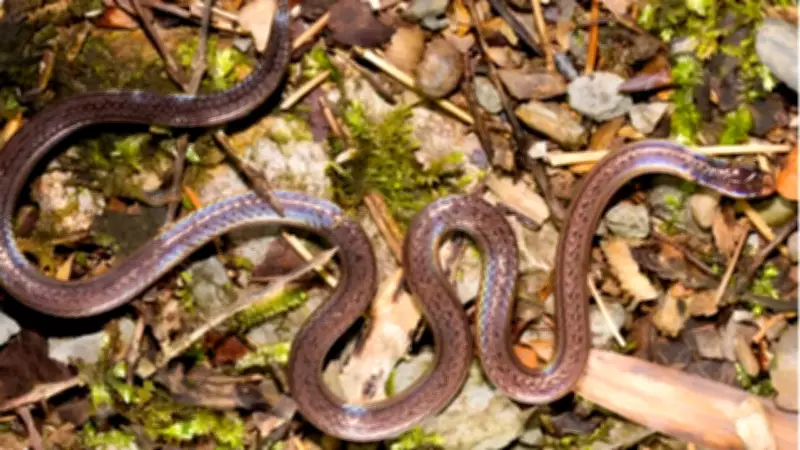
Experts say discoveries like this are still surprisingly common in remote forest regions where wildlife remains poorly studied. The snake itself is very small, measuring only around 22 centimeters in length. It has a slender body covered in brown coloring with seven broken dark stripes along its back. Researchers also described a distinctive net-like pattern formed by the dark edges of its scales.

Why is it called the “two-headed snake”?
The unusual nickname comes from the snake’s defensive behavior rather than its appearance alone. According to researchers, Calamaria incredibilis curls itself into a figure-eight shape when disturbed and lifts its blunt tail upward. The tail closely resembles its head, creating the illusion that the animal has two heads. Experts suggest this behavior likely evolved as a survival mechanism designed to confuse predators. Birds or mammals attempting to attack may hesitate because they struggle to identify which end is the actual head. The tactic appears simple, but it can be effective in the wild. Many reptiles use forms of mimicry to avoid predators, though scientists say this species displays the behavior in a particularly noticeable way. The nickname “two-headed snake” quickly spread online because the defense mechanism is both unusual and visually striking.
Two-headed snake behavior
Despite the dramatic nickname, researchers say the species is harmless to humans. The snake is non-venomous and reportedly has a mild temperament. It also moves slowly and spends much of its life hidden beneath leaf litter, loose soil, and small rock crevices. Scientists describe the reptile as semi-fossorial, meaning it prefers to remain partially underground for protection. It mainly feeds on earthworms and insect larvae found within damp forest environments. Because of its secretive lifestyle, experts believe the species may have existed unnoticed for a very long time. Researchers also noted that dense mountain forests in Guangxi provide ideal conditions for hidden biodiversity. Remote ecosystems often allow small reptile and amphibian species to survive undisturbed for decades before being officially recorded by science.

China’s growing list of rare wildlife species
The discovery of Calamaria incredibilis marks the second newly identified species reported this year from the Huaping reserve. Earlier, scientists also documented the Leptobrachella cathaya, commonly known as the Huaping leaf litter toad. That amphibian attracted global attention because it became recognized as the world’s 9,000th recorded amphibian species. Researchers say these discoveries demonstrate the ecological importance of protected forest reserves in China. Many experts believe large numbers of reptile and amphibian species may remain undocumented, especially in isolated mountainous regions where human activity remains limited.
China has increasingly focused on biodiversity conservation and habitat protection in recent years. Scientists suggest discoveries like this provide valuable opportunities to study evolution, adaptation, and fragile forest ecosystems that might otherwise remain poorly understood.